"My rule was I wouldn't recruit a kid if he had grass in front of his house.
That's not my world. My world was a cracked sidewalk." —Al McGuire

Thursday, June 23, 2022

Who Will Score? Part II: Shaka Smart

Shaka Smart will say goodbye to leading scorer Justin Lewis
 Photo by Mike de Sisti | Milwaukee Journal-Sentinel

In our last edition, Cracked Sidewalks looked at Marquette's history when it comes to the loss of volume points per game scoring and whether that has an impact on subsequent offensive efficiency. Because Marquette is losing four of the top seven points per game scorers, the obvious question we are trying to answer is "Who Will Score" in 2022-23.

Today, Cracked Sidewalks has gone back and looked at the entire coaching career of Shaka Smart. Due to relevance, we are also looking at the final seasons of the coaches that preceded him: Anthony Grant at VCU, Rick Barnes at Texas, and Steve Wojciechowski at Marquette. Using the same method as the last article, we are starting with the total number of points scored. We are then looking at the number of significant points lost, which were points scored by players that averaged 5.0 ppg or more. Using those two numbers, we could establish the percentage of significant points lost and match that up with the team's Adjusted Offensive Efficiency Rank as well as the Rank Change for the following year once they lost that percentage of points.

These seasons include Smart's entire career, with the "VCU/TX/MU" designations indicating the years before Coach Smart took over so we can see what impact his hiring had. We will again start with the raw data and then break it down into smaller bits to look at trends.

Year Total Pts Sig Pts Lost % Pts AdjO Rank Rk Change
2021-22 2369 1329 56.1 64 ??
2020-21 MU 1883 1450 77.0 94 30
2020-21 2008 1069 53.2 28 2
2019-20 1989 0 0.0 153 125
2018-19 2628 1375 52.3 29 -124
2017-18 2450 802 32.7 89 60
2016-17 2215 1084 48.9 177 88
2015-16 2355 1226 52.1 49 -128
2014-15 TX 2290 675 29.5 47 -2
2014-15 2609 934 35.8 58 0
2013-14 2624 749 28.5 106 48
2012-13 2770 680 24.5 20 -86
2011-12 2448 484 19.7 96 76
2010-11 2864 1671 58.3 47 -39
2009-10 2737 598 21.8 28 -19
2008-09 VCU 2440 937 38.4 64 36

While Smart's 2021-22 team sees 56.1% of the significant scoring depart, his team last year had more to replace, as did his 2010-11 Final Four team, with nearly opposite results. Last year they replaced 77.0% of the scoring and saw the Adjusted Offensive Efficiency improve by 30 spots while in 2011 he lost 58.3% of the scoring and saw the Adjusted Offensive Efficiency decline by 39 spots. Let's group it out to see if there are any meaningful trends.

Major Point Losses: 60+%

Year Total Pts Sig Pts Lost % Pts AdjO Rank Rk Change
2020-21 MU 1883 1450 77.0 94 30

Compared to Marquette's own history, Smart has quite the short list. The only time he had to replace more than 60% of his scoring was last year when he took over Marquette from Steve Wojciechowski and saw a significant Offensive Efficiency improvement. Bear in mind the only number here that is actually Smart's responsibility is the "Rank Change" improvement. If this says anything, it might be that Smart is better at balancing classes and retaining players so that the only time he's ever been in position to replace so much was taking over a new program.

Moderate Point Losses: 40-59%

Year Total Pts Sig Pts Lost % Pts AdjO Rank Rk Change
2010-11 2864 1671 58.3 47 -39
2021-22 2369 1329 56.1 64 ??
2020-21 2008 1069 53.2 28 2
2018-19 2628 1375 52.3 29 -124
2015-16 2355 1226 52.1 49 -128
2016-17 2215 1084 48.9 177 88

Hard to look at this and not see those two massive declines. The -124 and -128 are the two biggest drops in the 37 total seasons we reviewed between Smart's career and Marquette's history. And yet Smart's second greatest single-season improvement is also in this category. It's worth noting the 2 point improvement was made by Chris Beard as that was Smart's last season at Texas. The data here indicates Smart has at times struggled replacing significant scoring, though the small sample size and the 2017 outlier definitely shows it's not a definitive struggle.

Minor Point Losses: 20-39%

Year Total Pts Sig Pts Lost % Pts AdjO Rank Rk Change
2008-09 VCU 2440 937 38.4 64 36
2014-15 2609 934 35.8 58 0
2017-18 2450 802 32.7 89 60
2014-15 TX 2290 675 29.5 47 -2
2013-14 2624 749 28.5 106 48
2012-13 2770 680 24.5 20 -86
2009-10 2737 598 21.8 28 -19

This brings us back to the essential "nothing matters" conclusion. Three seasons where most of the scoring is retained end up in improvements, three end up in declines (including bizarrely the two that kept the most), and one had no change (though that was in a coaching change to Will Wade).

Minimal Point Losses: 0-19%

Year Total Pts Sig Pts Lost % Pts AdjO Rank Rk Change
2011-12 2448 484 19.7 96 76
2019-20 1989 0 0.0 153 125

Another small sample size, but retaining 80+% of his scoring led to big improvements in the rare events when it's happened. The general takeaway seems to be that while losing scoring won't necessarily hurt you, retaining scoring seems likely to help. Though all one has to do to question that is look at the two entries immediately above these minimal loss results.

Summary

In total, there were 37 past seasons reviewed between Marquette's history and Smart's career. When looking at the most extreme outliers, there were four seasons classified as minimal loss (less than 20% of significant scoring lost) and four seasons classified as major loss (60% or greater significant scoring lost). With last year's 77% loss resulting in a 30-spot improvement with the transition from Wojciechowski to Smart being the outlier, the other seven results all resulted in improvement or decline as would be expected. So at the extremes, keeping scoring is good and losing scoring is bad.

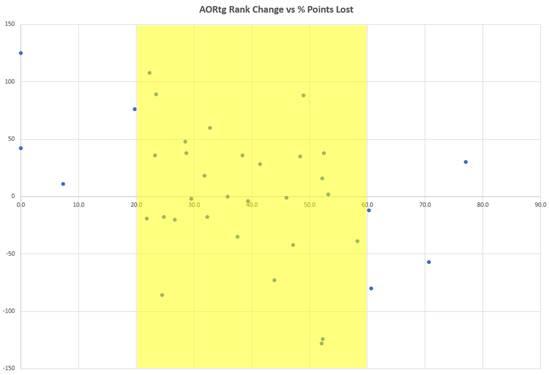
The scatter plot below supports that. When you look at the seasons where the Percent of Points Lost (X-Axis) is below 20%, it always yields positive results in the AORtg Rank Change (Y-Axis). When you look at seasons where the Percent of Points Lost is greater than 60%, it usually yields negative results (2021-22 was the 77% outlier).

However in the minor and moderate ranges, highlighted yellow on the plot, the results were all over the place. In 17 seasons of minor loss (20-39%), there were 8 teams that improved, 8 teams that declined, and one team that stayed the same, with the range being anywhere from an 86 spot decline to a 108 spot improvement. In 12 seasons of moderate loss (40-59%), there were 6 teams that improved and 6 teams that declined, with the range being anywhere from a 128 spot decline to an 88 spot improvement.

Trivia Answer: Justin Lewis' 16.8 ppg is the most ever for a player under Shaka Smart
Photo by Aaron Gash | AP Photo

Back to our trivia question from our preview article, Justin Lewis' 16.8 ppg is the most ever scored by a player on a Shaka Smart team. If anything, that should be reassuring to fans as typically, Smart simply doesn't have offenses that heavily revolve around one player. Replacing scoring is always going to be a team effort. Treveon Graham (16.2 ppg in 2014-15, 15.8 ppg in 2013-14, 15.1 ppg in 2012-13), Jamie Skeen (15.7 ppg in 2010-11), and Isaiah Taylor (15.0 ppg in 2015-16) are the only other players to reach the 15 ppg mark. In general, the scoring load for Smart is spread among a number of players rather than centered on one or two individual talents like we've sometimes seen at Marquette in recent years.

If there's any takeaway, it's that when you lose between 20-60% of your scoring, there's virtually no correlation between an offensive efficiency improvement or decline. Statistically speaking, replacing scoring is not something fans should get worked up about.

Friday, June 17, 2022

Who Will Score? Part I: Marquette

Justin Lewis has his eyes on the NBA Draft

Photo from @jusbuckets on Instagram

With Marquette losing four of their top seven points per game scorers from the 2021-22 season, Cracked Sidewalks is going to comb the history of Marquette offenses to see what happened when teams lost significant scoring as we try to answer the question of "Who Will Score" in 2022-23.

To answer this, Cracked Sidewalks went back and looked at the past 24 seasons of Marquette Basketball. We started by looking at the total number of points scored. We then looked at the number of significant points lost, which were points scored by players that averaged 5.0 ppg or more. Using those two numbers, we could establish the percentage of significant points lost and match that up with the team's Adjusted Offensive Efficiency Rank as well as the Rank Change for the following year once they lost that percentage of points.

The reason for that number was because we wanted to include Kuath as a floor, but if we included everyone, we would be looking at walk-ons and garbage time players who don't usually factor heavily into results. Apologies to the Duane Wilsons (4.8 ppg in 2016-17) of the Marquette world, but you didn't have enough offensive output to be a major factor in most games in your final Marquette season, even if that Villanova hesi will live forever in Marquette lore. Using those numbers, we were able to determine the percentage of significant points lost, compare that to the Adjusted Offensive Efficiency rank on Kenpom, and evaluate if losing volume scoring equated to a loss in team offensive quality.

Duane Wilson vs Villanova, a little Marquette basketball porn
 GIF courtesy of Anonymous Eagle

Why 24 seasons? It allowed us to capture the complete Marquette careers of Tom Crean, Buzz Williams, and Steve Wojciechowski, as well as the last year of Mike Deane and the first year of Shaka Smart. We didn't go further because, well, kenpom doesn't go back much further that. But it does seem like a pretty solid sample size. We'll start with the raw data, but since it's a lot to digest, we will break that down into smaller bits to look for trends.

Year Total Pts Sig Pts Lost % Pts AdjO Rk Rk Change
2021-22 2369 1329 56.1 64 ??
2020-21 1883 1450 77.0 94 30
2019-20 2333 1413 60.6 14 -80
2018-19 2629 836 31.8 32 18
2017-18 2846 757 26.6 12 -20
2016-17 2631 1034 39.3 8 -4
2015-16 2517 561 22.3 116 108
2014-15 2083 1094 52.5 154 38
2013-14 2310 1631 70.6 97 -57
2012-13 2382 1045 43.9 24 -73
2011-12 2638 1237 52.2 40 16
2010-11 2782 900 32.3 22 -18
2009-10 2485 1142 46.0 21 -1
2008-09 2739 1652 60.3 9 -12
2007-08 2658 193 7.3 20 11
2006-07 2443 0 0.0 62 42
2005-06 2325 872 37.5 27 -35
2004-05 2080 1006 48.4 62 35
2003-04 2207 546 24.7 44 -18
2002-03 2589 1219 47.1 2 -42
2001-02 2413 999 41.4 30 28
2000-01 1902 544 28.6 68 38
1999-00 1820 422 23.2 104 36
1998-99 1823 427 23.4 193 89

The first takeaway is that while Marquette is losing 56.1% of last year's points from significant scorers, that isn't the high-water mark. 2021, 2014, 2020, and 2009 all saw teams lose more than 60% of their scoring. And while 56.1% is in the upper range, that is just one of 12 totals where teams lost 40+% of their scoring from significant scorers, so there's plenty of comparable company. To make this easier to digest, let's group these out a bit.

Major Point Losses: 60+%

Year Total Pts Sig Pts Lost % Pts AdjO Rk Rk Change
2020-21 1883 1450 77.0 94 30
2013-14 2310 1631 70.6 97 -57
2019-20 2333 1413 60.6 14 -80
2008-09 2739 1652 60.3 9 -12

The first thing that jumps out here is that three of the four teams in this group saw declines in the subsequent years. Despite that, the team that lost the most in 2020-21, when Wojo was fired and the top-5 scorers left, was the one that saw significant improvement. Shaka's new system, player improvement, and smart roster additions made up for those departures. The biggest falloff came when Markus Howard left, joined by Sacar Anim and Brendan Bailey. The problem there, however, was not so much a lack of quantity (Dawson Garcia, DJ Carton, and Koby McEwen all averaged 10+ ppg) and more one of quality as no one could replicate Howard's efficiency at that usage rate.

One thing that stands out the most might be 2008-09, which was when the Amigos left Marquette. Despite their departure, the 9th ranked offense only fell to 21st thanks to players like Lazar Hayward, Jimmy Butler, and Maurice Acker providing efficient offense and scoring volume. In this case, I would point to smart coaching as the reason the decline was relatively minimal. In 2009-10 Buzz Williams focused on shooting (5th nationally in 3PFG%) and turnover rate (7th lowest) while also slowing the pace (from 67.5 to 62.3 possessions per game) in order to maximize the impact of his shooters. What this (and 2020-21) tells you is that you can lose a ton of scoring and still maintain an efficient offense if the coach is good enough to overcome the loss of even efficient scorers.

It's also worth noting that the 2021 and 2014 teams represent two of just three times that Marquette lost five players who averaged 5+ ppg, though with radically different next season results.

Moderate Point Losses: 40-59%

Year Total Pts Sig Pts Lost % Pts AdjO Rk Rk Change
2021-22 2369 1329 56.1 64 ??
2014-15 2083 1094 52.5 154 38
2011-12 2638 1237 52.2 40 16
2004-05 2080 1006 48.4 62 35
2002-03 2589 1219 47.1 2 -42
2009-10 2485 1142 46.0 21 -1
2012-13 2382 1045 43.9 24 -73
2001-02 2413 999 41.4 30 28

If ever there was a chart that shows how meaningless retaining scoring volume is, this is probably it. We don't know the fate of the 2022 departures, but four of the other seven teams actually improved their offensive rank. If you add up the previous seven, the +/- rank comes out to 1, which means the average rank change of teams losing between 40-59% of their scoring over this period was 0.14. There were certainly some big swings in there, but by and large the average change is effectively zero.

It also seems worth noting that while there are some great departing classes on this list, such as Crowder and DJO in 2012 (16 spot improvement), Diener and Mason in 2005 (35 spot improvement), and Wade and Jackson in 2003 (42 spot decline), the biggest decline in the group came from the second smallest percentage of significant points lost when Vander Blue, Junior Cadougan, and Trent Lockett left in 2013.

Minor Point Losses: 20-39%

Year Total Pts Sig Pts Lost % Pts AdjO Rk Rk Change
2016-17 2631 1034 39.3 8 -4
2005-06 2325 872 37.5 27 -35
2010-11 2782 900 32.3 22 -18
2018-19 2629 836 31.8 32 18
2000-01 1902 544 28.6 68 38
2017-18 2846 757 26.6 12 -20
2003-04 2207 546 24.7 44 -18
1998-99 1823 427 23.4 193 89
1999-00 1820 422 23.2 104 36
2015-16 2517 561 22.3 116 108

The overall +/- rank for these 10 seasons comes out to +194, which initially might seem like it supports there being a big benefit to returning players, but I would point to the circumstances around those seasons as well. How much of that massive 1998-99 to 1999-2000 jump was personnel change and how much was it having a flat out better offensive coach as that was the year Tom Crean replaced Mike Deane. How much was 2015-16 a product of not losing much (really just Henry Ellenson) and how much was adding Markus Howard, Andrew Rowsey, Sam Hauser, and Katin Reinhardt? And why would half of the seasons in this category see the offense get worse?

Minimal Point Losses: 0-19%

Year Total Pts Sig Pts Lost % Pts AdjO Rk Rk Change
2007-08 2658 193 7.3 20 11
2006-07 2443 0 0.0 62 42

Again, this might indicate some support about returning scorers, but the numbers here are in line with the improvement seasons in the 40-59% category, so maybe the takeaway is that the Amigos got better the longer they were here. Further, two seasons is a pretty small sample size, so it's hard to take much away from this. What this really shows is that losing volume scoring doesn't tell you much about what will happen the next season.

Players step up into scoring roles because the game demands it. When Dwyane Wade left, it was Travis Diener and Steve Novak. When the Amigos left, it was Hayward and Butler. When Crowder and DJO left, it was Blue, Jamil Wilson, and Gardner. When Ellenson left, it was Howard and Rowsey. And when Garcia, Carton, and McEwen left, it was Justin Lewis, who improved his 7.8 ppg with a 93.8 Adjusted Offensive Rating as a freshman to 16.8 ppg with a 101.9 Adjusted Offensive Rating in an NBA-caliber season.

Summary

Ultimately, at Marquette there has been virtually no correlation between losing volume scoring and a comparable decline in offensive efficiency. Some teams that lost a lot, like 2004-05 with Travis Diener and Dameon Mason departing or 2011-12 with Jae Crowder and Darius Johnson-Odom graduating, actually improved the next year in terms of offensive efficiency. Last year's team had to replace more significant scoring than any other season in 24 years and not only didn't get worse, they got significantly better on the offensive end.

Crowder & DJO left in 2012, but Vander Blue & Jamil Wilson led a better 2013 offense

Photo by Christian Peterson | Getty Images

At the other end, some teams that lost relatively little, such as the 2003-04 team with Scott Merritt and Terry Sanders or the 2017-18 team that really only lost Andrew Rowsey still took steps back despite retaining most of their scoring. And sometimes these do go to expectation, such as the 2019-20 team losing Markus Howard and Sacar Anim as the team took a big step back or the 2006-07 team retaining all of their significant scoring and improving significantly with that continuity. The bottom line is that the simple loss of volume scoring is not a guarantee that a team will step back offensively, so Marquette fans concerned about the loss of Lewis and Morsell may want to pump the brakes before worrying about next season's offense.

Thursday, June 16, 2022

Coming Soon: Who Will Score?

Marquette loses four of their top seven scorers from 2021-22

Photo from Marquette Athletic Department

In a move that goes against what many collegiate basketball prospects did over the past few weeks but wasn't much of a surprise to Marquette fans, Justin Lewis will be staying in the NBA Draft. The departure of Lewis (16.8 points per game), coupled with the departures of Darryl Morsell (13.4 ppg), Greg Elliott (7.0 ppg), and Kur Kuath (5.6 ppg) means that Marquette has lost four of their top seven players in terms of per game scoring.

Unsurprisingly, Marquette Twitter and forums have lit up with concerns about how next year's team will score without these players returning, particularly Lewis who figured to be a Big East Player of the Year favorite if he returned. But while it seems logical that losing scoring will have a negative impact on the offense, is that really true?

While the answer might seem obvious in that losing good offensive players would hurt the offense, what we are looking at here is if losing volume scoring (which Marquette did) has an impact on offensive efficiency. I would remind readers that Marquette had the 21st most efficient offense nationally in the year AFTER Jerel McNeal, Wes Matthews, and Dominic James graduated and the offensive efficiency actually improved in the season after Jae Crowder and Darius Johnson-Odom graduated.

Cracked Sidewalks is going to look at this in four parts. The first is whether or not losing volume scoring has had an impact on offensive efficiency at Marquette historically. We will look at the statistics over the kenpom era in terms of losing volume points and whether there is any clear trend on the next year in terms of offensive efficiency.

The next thing we will look at will be how Shaka Smart has fared when it comes to replacing volume scoring. This will essentially mimic the first part but will do so through the lens of Marquette's current head coach, while also reviewing the seasons before he took over to give better context to how his debut seasons tend to go.

The final thing we will look at will be the contenders to take the scoring load. We know that Lewis and Morsell won't be pouring in points, so which returning players are the best bets to fill that void and step up in clutch moments? Cracked Sidewalks will identify the three most likely Marquette scoring leaders for 2022-23.

Finally, we will look at the dark horses to have a major scoring impact, examining not just who those wild cards are, but why we don't have them in that "leading contender" category. These will be the players who could play a role in 2022-23 and in terms of scoring might get there some day, but don't expect them to be offensive leaders in the coming season.

To put a bow on this introduction, we will leave you today with a trivia question that will be answered later in this series. Which player on a Shaka Smart-coached team has the highest single-season points per game average? Keep reading Cracked Sidewalks for the answer.

Monday, June 13, 2022

You are looking live.....

It's been a bit but #ScrambledEggs is not only back, but back live. We recorded this podcast in person from an undisclosed murder basement and it could not have gone better. We talk off season roster changes, what next season looks like, and the TBT among other things. As always, enjoy! https://scrambledeggs.podbean.com/e/you-are-looking-live/

Tuesday, May 24, 2022

2022-23 Marquette Schedule Update

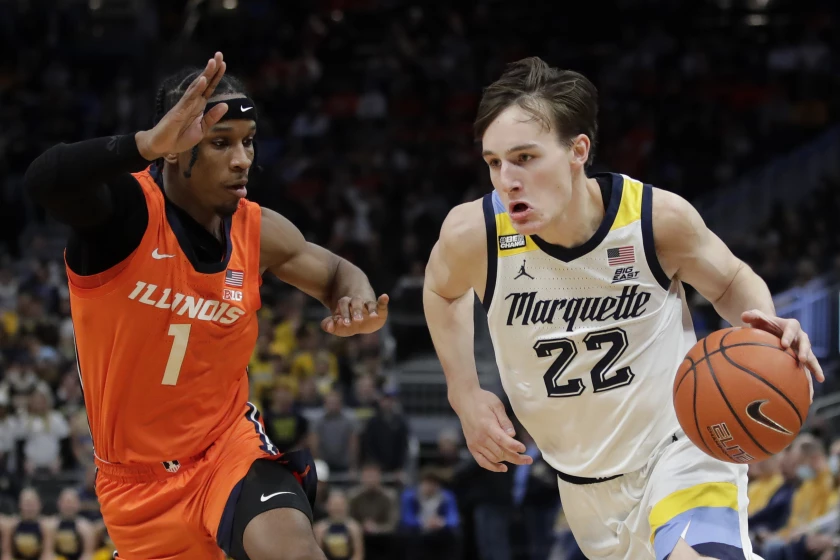
Tyler Kolek gave Marquette fans a little magic against Illinois in 2021
 Photo by Aaron Gash | AP Photo

We're moving into summer, which means there isn't a lot of Marquette news coming out. While we all await a final decision from Justin Lewis, a TBT tournament roster and (hopefully deep) run, and the impending hot weather to clear out so we can get back to basketball season, I thought I'd take some time to update everyone on what we know about Marquette's non-conference schedule.

Season Opener: Radford on November 7th

After being perennial Big South contenders under Mike Jones, it didn't start well for Darris Nichols, who posted the Highlanders' first losing record since 2017. They project to be even worse in year two, but have a radically different roster thanks to the transfer portal. This should be a soft start.

Fort Myers Tip-Off: LIU on November 17th, Georgia Tech/Utah/Mississippi State on November 21st & 23rd

LIU projects as the worst of the Palms Division campus games according to T-Rank, but they do have some upside thanks to three returning starters. On paper, Georgia Tech and Mississippi State are the two best potential opponents in Fort Myers, but Marquette should come into the tournament as a favorite on paper regardless of the draw.

Baylor on November 29th

This is the big one. The Bears project as a preseason top-10 team like Illinois did last year and have national title aspirations after winning it all in 2021. Mark your calendars, this could generate a lot of buzz, especially if Marquette comes into this one undefeated.

UW-Madison on TBD (December 3rd)

Unless they put this on a Sunday, the date for this will be December 3rd, making for a big week at Fiserv with Baylor and Bucky back-to-back. With Johnny Davison and Brad Davison (finally) gone, this should be a down year for the Badgers, but we hear that every year, so don't expect it to really happen. Why are we so confident in December 3rd? It won't be the first weekend of the season, it won't be in the middle of Fort Myers, and it won't be the week after (Notre Dame) so that really only leaves one realistic date on the calendar.

At Notre Dame on December 11th

Marquette renews the series with Notre Dame with a home and home starting on the road. It's a bit surprising that this will be on a Sunday, but any way we get this series back is welcome so let's just celebrate that it's happening. T-Rank projects the Irish as a top-half ACC team, so this should be a tough challenge.

TBD: Gavitt Games

Marquette isn't guaranteed to be included (Butler, Georgetown, Villanova, Xavier should be locks based on only playing 4 previous Gavitt Games) but it's a strong bet that we'll have a road Gavitt Game. If you're wondering where we might be headed, Iowa, Maryland, Michigan State, Minnesota, Northwestern, Penn State, and (ugh...again?) Purdue all have yet to fulfill their Gavitt obligations, so those are the most likely destinations.

TBD: Home Games

If this all comes to pass, that gives Marquette six high-major games and two low-major games. It also puts four home games on the schedule to go along with the eleven known Big East home games. Expect the last three to all be guarantee games. I would be surprised if one of them isn't a fairly ambitious buy game. While the 2015-16 Belmont game came from an exempt tournament, Marquette pursued a quality non-con guarantee game in every non-conference schedule. 2016-17 Fresno State, 2017-18 Vermont, 2018-19 Buffalo, and 2019-20 North Dakota State were all coming off NCAA bids. Don't be surprised to see similar ambition with one of those games going to a tourney team like Montana State or a high-upside mid-major like Toledo.

Wednesday, April 27, 2022

Move Fast & Break Things

Justin Lewis promoting Uncle Buck's Duck Nachos
Photo from @jusbuckets on Instagram

The era of Name, Image, and Likeness is here for college basketball, and it seems like Marquette is mostly taking a wait and see approach. We are here today to say why that is categorically a mistake and that the University should be pulling every string possible to push the limits of NIL if they want to thrive in this era. Marquette is in a rare position where they should be as proactive as possible because by moving fast and not being afraid to test the boundaries, they can do so with virtual assurance that there will be no repercussions when they do try to innovate in this space.

We are going to look at this from four different angles. First, the ethics and laws around it. Second, how NIL could be used to help Marquette's roster building under Shaka Smart. Third, what other programs are doing. Fourth, why NIL opportunities should be considered not just viable but part of the foundational culture at Marquette and what possibilities they could investigate. Finally, we end with a plea to the fans if Marquette still isn't willing to lead of its own accord. Let's get started.

Ethics and Laws

From the NCAA's own release when NIL passed, they stated "College athletes who attend a school in a state without an NIL law can engage in this type of activity without violating NCAA rules related to name, image and likeness." Essentially, the message was "go ahead, we aren't going to stop you and aren't going to regulate this." According to the April 24, 2022 Business of College Sports update, no legislation has been introduced in the state of Wisconsin. That article lists the NIL status of 42 different states. Of those 42 states, Wisconsin is the ONLY ONE that does not have legislation that is passed or pending. So what does that mean? There are no regulations in terms of what Marquette can do when it comes to NIL opportunities for their athletes. To reinforce how important the lack of laws is, look no further than Alabama, which was one of the first states to enact NIL legislation on July 1, 2021, but repealed that legislation earlier this year because the NCAA stance was even more lenient than the state's was. “When we were in session last year, we were under the assumption that the NCAA would allow state law to prevail,” Alabama State Representative Kyle South said. “In the case that we did nothing, then our student-athletes may or may not have been able to use the NIL and be compensated for name, image, and likeness. So we adopted a set of standards. Later in the summer, the NCAA went back and adopted their own set of standards that are less restrictive than what we adopted back in the spring.”

While that could change in the future, we exist in a time period where neither the NCAA nor the state have passed any legislation, which means anything Marquette does would be legal. The NCAA in abdicating a position on how to run things has shown they are not going to stop programs. And while a change in Wisconsin law could alter compliance, nothing Marquette did RIGHT NOW would violate any law, which means they can come in line if and when such a line ever exists. I cannot stress enough, without laws on the books, Marquette is in one of the strongest positions in the country in terms of NIL. Marquette shouldn't wait for the state, they should take advantage of the state's inaction. This is exactly why a state like Alabama repealed their law, which gives their flagship universities free rein to provide maximum freedom to their student athletes.

In addition, we have seen in the past what the NCAA does when something happens they disagree with but is being done by too many programs to regulate. Once upon a time, "don't tweet at recruits" was a thing. Yet any time a high-profile recruit posts on social media, fans of programs like Arkansas, Illinois, Kentucky, North Carolina, and countless others flood the posts with likes and responses. No action has ever been taken against programs in regard to fan accounts interacting with these posts. They may take action if it's a coach, but nothing is done when it comes to fans. Yet at Marquette, when a recruit is active on social media, our fanbase is full of crickets because "don't tweet at recruits" was drilled into us over the course of the past decade.

This isn't to advocate 30 and 40-somethings climbing into the mentions and DMs of their favorite recruits. But if a motivated group of 15-20 students wanted to "show love" to recruits, or a bot farm was generating positive Marquette feedback to recruits, however it was set up or whoever had the controls, it might help prevent social media posts like the above from Marquette targets and commits. Like it or not, we live in an attention-driven world, and when high-profile basketball recruits expect attention, it's best to just "show love" as a demonstration of fanbase passion because no matter how high-and-mighty Marquette fans or administration might want to be, this is unquestionably happening at other schools, being asked for by the players we recruit, and I assure you has not gone unnoticed by our own basketball staff.

Roster Building

Shaka has spoken recently about how he wants to build his roster. "I love the opportunity to develop relationships with guys while they're still in high school...to help them become full-fledged, grown men. The problem with that is retention...there's a whole lot of guys in college basketball moving around...We're still going to build our program primarily through high school kids. That doesn't mean we would never take a transfer, I think it would be irresponsible to not at least look." I'm sure as fans and Marquette's administration see the Pack deal, they think about how NIL doesn't apply, but that would be a huge mistake.

As Smart said, players are moving around for various reasons. If you have a strong NIL foundation that makes sure your players are financially taken care of throughout their Marquette careers, that will lessen their need to look elsewhere, whether that elsewhere is another program or the professional ranks.

Consider first Justin Lewis. He is largely projected as a second-round pick, which Paint Touches recently showed is fairly unreliable in terms of guaranteeing a big payday. If Justin were drafted in the second round, or went undrafted, but was offered a 2-way NBA contract, he would be guaranteed roughly half the NBA league minimum, or around $500,000. What if Marquette put together a NIL package close to that for Justin? Come back, make the same money you would on a 2-way, and instead of playing in front of sparsely populated G-League gyms and internet streamers most nights, you could play on national TV for another year in front of packed Big East arenas every night.

What if someone like Kam Jones, Oso Ighodaro, or Tyler Kolek has a star turn this year and could be the next Nijel Pack? Wouldn't Marquette be better served to try to uphold the retention Smart is calling for by making sure these athletes are taken care of before they have to make such a decision? Establishing a strong, vibrant NIL foundation will have Marquette in position to retain the players Smart wants to develop while also having the ability to reach out for those top transfers when they do fit the culture he is trying to build.

NIL Around the Country

Obviously Miami landing Pack through their partnership with Hurricane alum John Ruiz's LifeWallet is one of the biggest statements of the offseason, as is the return of Oscar Tshiebwe at Kentucky with a reported $2,000,000 payday. But it's worth noting that Caleb Love and Armando Bacot returning to North Carolina, Zach Edey to Purdue, and Hunter Dickinson to Michigan, among others, show that top players are willing to continue playing in college in this era. NIL may not be the only factor, but it is certainly one factor for guys that could just as easily be headed overseas to make money if the NBA wasn't going to offer them contracts.

The DYME app connects Arizona fans directly to athletes on an exclusive platform
 Image from @dymetv Twitter

A company offered a $1,000 stipend to all BYU scholarship and walk-on athletes in their football program. Arizona partnered with the DYME App to allow fans to have direct access to fans on an exclusive social media platform. Arkansas boosters have created a consortium connected to various non-profit organizations to provide opportunities for their players. Companies like Gatorade, Newegg, and Cash App have inked individual deals with athletes.

College basketball is retaining top talent in a way it hasn't in years. Programs are benefiting from that largely due to the opportunities NIL offers. And while this likely won't fundamentally change the everlasting reality that the blue bloods are best at attracting top players and marquee programs are the ones that win, there is clearly the opportunity for creative programs to carve a niche. Provided they are willing to move fast and not be afraid to break things. Because at this time, the NCAA doesn't have a clear prohibition and Wisconsin doesn't have any laws preventing it.

Marquette's NIL Role

There will be skepticism about what a relatively small Jesuit school in the Midwest can do when it comes to NIL. However let's not forget that the joint article The Case Against Steve Wojciechowski was published on March 18, 2021 and on March 19, Marquette had pulled together the estimated $6,000,000 it took to force Wojo to walk away. Marquette has wealthy donors that can put money in the pockets of players. And let's not forget, as of 2020 Marquette had the 8th largest basketball budget in the country. The money to fund that comes from donors.

It wasn't cheap for Marquette to dismiss Wojciechowski
 Photo by Dave Kallman | Milwaukee Journal-Sentinel

While you can debate how it compares to football schools that likely earmark facilities to that progam, there are a few facts worth looking at. First, Marquette's basketball budget is the highest of any non-football school. No program outside the high-major football programs and the Big East are ranked in the top-25 of budgets. And college basketball is king at Marquette, a sport that only has 13 scholarship players compared to the 85 that football has. If Marquette's alums want to be a major player in the basketball NIL game, they can absolutely do that.  Let John Ruiz pledge his $10,000,000 to Miami athletes, the bulk of that money will go to football players which opens the door for basketball-dedicated donors and fanbases like Marquette's to not just compete, but thrive because the cost of admission will be lower.

It's also important to consider Marquette's position both historically and as an institution. Many of the older fans like to point not to the 1977 National Championship team but the 1972 team that was ranked #2 nationally and undefeated when star center Jim Chones left the team in the middle of the season to enter the ABA Draft as Al McGuire's best. McGuire didn't begrudge the decision Chones made that seemed to kill Marquette's season. The Warriors were 21-0 when Chones left but finished the season 4-4 including a season-ending loss to a Minnesota team they had beaten by 15 earlier in the year. When asked about the decision, McGuire reportedly endorsed Chones' decision, "because I've looked in my ice box and I've looked in his." If Marquette supporters at the time had been able to offer NIL deals to Chones, might McGuire have won a National Championship five years earlier? In 1983, might Rick Majerus have convinced Doc Rivers to stick around for one more year and started his Marquette coaching career in different fashion, perhaps allowing Rick to grow into the coach he became in Milwaukee instead of Utah? Might Vander Blue have returned in 2013-14, giving one more season to a team that was loaded in the front court but suffered from a lack of back court shot creation? Generation after generation at Marquette has seen how much NIL could help with those difficult decisions of when to go pro.
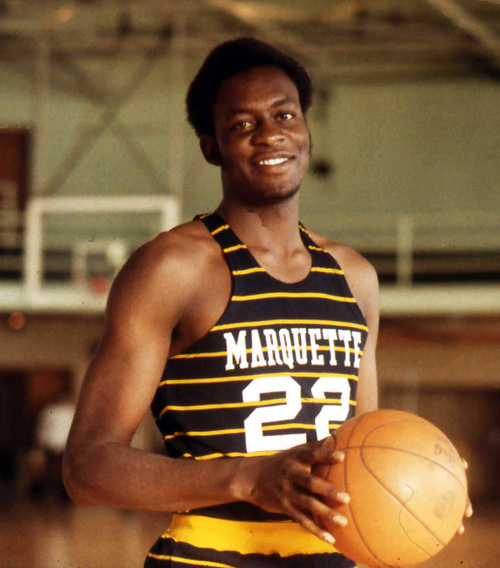
Would Jim Chones have chosen the ABA if NIL was an option?
Photo from nasljerseys.com

Another factor worth considering is Marquette's motto of Cura Personalis. Literally translated, it means "care for the whole person." Should financial opportunities not be a part of that when there has never been any restriction on other students, such as dental students, law students, communications students, nor any others to earn money as they see fit throughout their college career? And using the Arkansas charitable consortium listed above as a model, couldn't Marquette donors find a way to not only provide financial opportunities to their student athletes but to do so in a way that benefits the community by working with local charities? This is also an educational opportunity for the University. Too often we hear about athletes who are not prepared for the repercussions of fame and money that comes with it. Marquette should be finding ways to vet the NCAA approved agents for their athletes, teach them how to identify and select opportunities that help them improve their situation, and make sure they have a thorough financial understanding so none of them find themselves in the situation Milwaukee native Latrell Sprewell did when the 13-year NBA veteran and 4-time All-Star had his yacht seized and home foreclosed on due to financial troubles despite career earnings of nearly $100,000,000.

The Oscar Tshiebwe deal brings up interesting visa questions, as student visas don't seem to allow NIL deals. Perhaps Marquette, with Olivier Maxence-Prosper already on campus and Ben Gold coming in, could find a similar way that Kentucky did to amend their visas and open the door for Marquette to become a more attractive destination for international recruits. That might be important when it comes to Washington State transfer Efe Abogidi, who could be viewed as a Justin Lewis replacement if Lewis stays in the draft and Abogidi, who has Marquette on his list of 12 schools he is considering, were to pick Milwaukee for the remainder of his college career.

Whether it is creating a floor for all players (scholarship at minimum), allowing fans to directly funnel funds large or small to the players, creating a consortium that can collect and distribute NIL opportunities, or working with individual companies, the options are there. Whether it is someone like Uncle Buck's or larger corporations in Milwaukee, the options are there. And when the NCAA is abdicating any responsibility and the state has no laws, there is absolutely no reason Marquette shouldn't be doing everything in their power to lead the charge in order to retain the players they have and attract the players they want. And considering Marquette's rich recent NBA history, might there be ways to get Wes Matthews, Jae Crowder, Jimmy Butler, or Dwyane Wade involved in these opportunities? If there are no state laws regarding NIL, why not use NIL as photo ops to put current Marquette players next to Marquette legends of the recent past and have everyone come away with a paycheck?

Now is not the time for Marquette to sit on their hands. It is not the time to say "fans, don't get involved" the way they did with social media interactions years ago. It is the time to be aggressive, to take advantage of what Wisconsin legislation hasn't done, to move fast and to break things if necessary. It is the time to lead, not the time to be left behind. If you have to make mea culpas later, if you have to adjust to laws later, so be it. In an innovative environment, the best possible thing you can do is innovate, not wait for others to innovate around you and play catch-up when it's too late to be a major player.

A Final Plea

If Marquette doesn't choose to be the driver behind NIL initiatives, that doesn't mean that fans and boosters cannot get this started on their own. I would encourage Marquette fans to look at ways to support their student athletes. I suspect if you are still reading this, you already support the Marquette basketball program in one form or another. If you are a business owner, could your advertisements include Marquette athletes? If you are one of Marquette's well-heeled donors, could you start a consortium that provides that floor for scholarship (or all) players? Even if you are just a fan, why not make sure the memorabilia you buy either comes from the athletes directly (such as the Morsell Blue shirt or custom jerseys that benefit the players)?

On whom does NIL responsibility fall? You, Marquette fan, it's you.
 Photo by Maggie Bean | gomarquette.com

At this time, in this state, the hope has to be that Marquette chooses to lead and not simply follow. But if they do not do that, it is incumbent on the donors to be the ones that push this ahead and make sure that Marquette as an institution has the donor support to drive this, even if they have to be brought along incrementally. For those of you that have the ability and desire to fund Marquette's basketball ascendancy, this is the time for you to take the reins, even if the University is slow to act.