"My rule was I wouldn't recruit a kid if he had grass in front of his house.
That's not my world. My world was a cracked sidewalk." —Al McGuire

Friday, February 03, 2023

Blue Blooded Bubble

The current bracket matches North Carolina and Kentucky in Dayton

Photo from Getty Images

Digging into resumes this week, two teams really stood out when it came to the bubble discussion. Not only did North Carolina and Kentucky both end up among the last teams in the field, this week they are slated to play each other in Dayton, with the winner meeting Indiana.

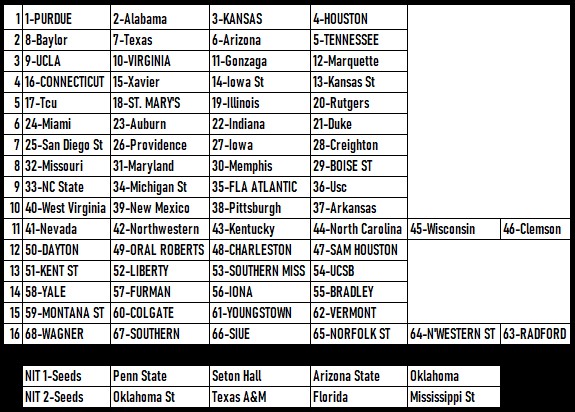
It's six weeks to Selection Sunday so a lot of this will change. But as it stands right now, Kentucky and North Carolina are both 1-6 against Quadrant 1 opponents. They both have losing records against Quadrants 1 and 2 combined. The main things holding them in the field are their metrics. Let's compare the resumes of the the current Dayton teams (last four in) and the NIT 1-seeds (first four out).

Looking first at Kentucky, they have great Predictive numbers and a solid NET, but that 1-6 Quadrant 1 mark is glaring and having a Quadrant 4 loss certainly doesn't help. What really buoys them into the field is who that Quadrant 1 win was against. They beat Tennessee on the road, which is one of the best wins in the country this season. While other bubble teams have more quality wins, none have a win that good coupled with the Wildcats' metrics.

For North Carolina, their lone Quadrant 1 win is less impressive. They beat Ohio State, who took a loss to Wisconsin last night and dropped to .500 on the year. UNC's only win against an at-large caliber opponent was over NC State at home, which is currently a Quadrant 2 win. But with no bad losses and good metrics, it's hard to keep them out entirely.

The last two teams in are Wisconsin and Clemson. Bucky's win at Ohio State vaults them back into the field. Not only does Wisconsin have 3 Quadrant 1 wins, all three are Quadrant 1A, which are the highest level of win recognized by the Selection Committee. Clemson is an odd case where they have some truly terrible losses but an incomparable 7-2 record in Quadrants 1 and 2 combined; only 1-seeds Purdue, Alabama, and Houston have a better Quadrant 1+2 winning percentage. Because we use highest NET instead of conference record, they don't get in as an automatic qualifier, but their resume average jumps off the table compared to the rest of the bubble. In for now, but hanging on by a string.

On the outside, it's a glut of high majors. Our first eight out are all from traditional Top-6 conferences. Penn State was strongly considered with 3 wins over the field, but a combined 4-8 in Q1+2 wasn't good enough to offset their metrics. Seton Hall is making a push of late and their 3 Quadrant 1 wins really stand out, but like Penn State the metrics weigh them down and they likely need to pick off another top Big East team before they cross into the field. Arizona State and Oklahoma both have a very good top-of-the-resume win, but just not enough volume of quality to overcome their negative factors.

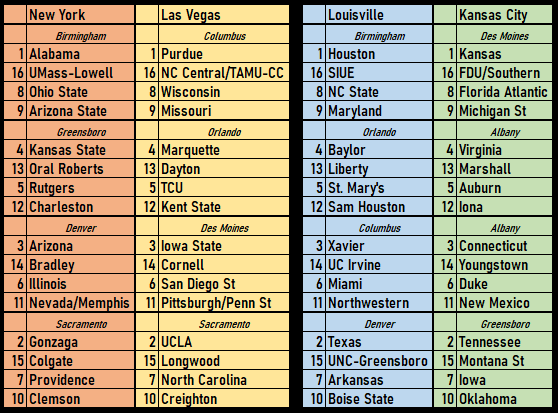
This will all certainly change in the next 6 weeks, but for Marquette fans, I imagine the storyline of Kentucky/North Carolina playing in Dayton for the right to take on Indiana (with UCLA in the same pod) would have storyline potential outmatched only by Marquette's own pod. This week we see MU matched up with alum Brian Wardle and Bradley, with the winner taking on the winner of Duke playing its own alumni match against Chris Collins and Northwestern. As much as people think the NCAA sets these storylines, sometimes it's just how the bracket falls.

Let's look at the S-Curve and bracket ahead of the weekend:


Multibid Leagues

Big 10: 9

ACC: 7

Big 12: 7

SEC: 6

Big East: 5

Mountain West: 4

Pac-12: 3

American: 2

WCC: 2

Tuesday, January 31, 2023

Big East on the Bubble

 Creighton's recent resurgence is moving them away from the bubble
 Photo by Mark Hoffman | JSOnline.com

With about a month left in the regular season, the Big East has divided itself into three very clear tiers when it comes to NCAA Selection. Today we'll take a quick look at those tiers, with a special focus on the teams that are still fighting to get into the field.

Should Be In: Marquette, Xavier, Providence, Connecticut

None of them can lose out and get in, but all four are trending toward comfortable single-digit seeds and could finish with a protected seed with a strong finish.

MSG or Bust: Butler, DePaul, Georgetown

A dedicated Butler fan could argue the merits of wins over K-State and BYU, but they would have to win out and that simply doesn't look realistic. Dedicated DePaul or Georgetown fans couldn't even offer that much support to their at-large cases.

Strong Case: Creighton (13-8 / 7-3 Big East)

Six-game losing streaks tend to kill NCAA resumes, but Creighton has bounced back nicely. They are 7-2 since Ryan Kalkbrenner returned and 13-5 with him in the lineup. The only knock is their low resume average (44.5), but once they get selected their predictive average (10.0) and NET (18) push them far up the S-Curve. They are now featured in 76/77 brackets on bracketmatrix.com and they are in all 72 brackets updated since January 25th. This team is trending toward a single-digit seed and off the bubble. To feel safe, they need to go 7-3 in their last 10 games.

Fighting Chance: Seton Hall (13-9 / 6-5 Big East)

The real problem is the lack of depth at the top of the resume. Wins over UConn and Rutgers are great, but 4-8 in Quadrants 1+2 isn't. They need to get that mark closer to .500 but without losing any more stinkers like Siena. The good news, their only two banana peels left are at home against DePaul and Georgetown. Win those and go 4-3 in their other games and they might have enough to get in. Anything more and they are probably at least in Dayton. That's a tough task, but Seton Hall is the Big East's best shot at getting a sixth bid. To feel safe, they need to go 7-2 in their last 9 games.

On Life Support: Villanova (10-11 / 4-6 Big East)

The return of Justin Moore gives Villanova a bit of a new lease on life. If they can surge to an 8-2 finish they might have enough to argue they are a different team with Moore in the lineup. Especially considering they already went from 2-5 without Cam Whitmore to 8-5 from the freshman's return until Moore joined him on the court. It's also notable that seven of their ten remaining games are Quadrant 1. Finish strong and they would present a complicated case at the minimum. While off the bubble radar for now, if Villanova finishes 8-2 in their last 10, they'll be a talking point for the Selection Committee.

Pull the Plug: St. John's (14-8 / 4-7 Big East)

Cue the Monty Python "I'm not dead yet" scene. Their non-conference was a smoke and mirrors record built on nine of eleven games being Q3+4. They started 1-5 in the Big East and looked to be finished, but then beat UConn on the road, which is one of the best on-paper wins any team in the country has. But they followed that up with losses to Villanova and Creighton. They need to go 7-2 in their last 9 to get in the conversation, and even that might not be enough.

Let's take a look at the current S-Curve and bracket:

Multibid Leagues

Big 10: 8

Big 12: 8

ACC: 7

SEC: 6

Big East: 5

Mountain West: 4

Pac-12: 3

American: 2

West Coast: 2

Monday, January 30, 2023

Gold out of Wintrust

Yet another solid week for #mubb and another demon slayed. We talk about the result down in Chicago and how it pushes forward the narrative of MU being an elite offense that can play defense when it wants. We also talk about MU being tied for first in conference and the reality of MU being able to win the conference outright. We then turn to the week ahead where we should try to go 2-0 but we'll see how it goes given the shortening of the bench due to injuries. We close out by talking about National Marquette Day. Have some Blue & Gold Brewing and spend time with friends on NMD and enjoy! https://mcdn.podbean.com/mf/web/c7vccq/ScrambledEggs_Editted_012923.mp3

Saturday, January 28, 2023

We Don't Talk About Marquette...No, No, No!

Let's hope no one talks about Marquette until after NMD

Photo from Disney's Encanto

The Three Man Weave podcast has raved about the Marquette offense. The Athletic has had numerous features on the program's recent ascension. When you are ranked #16 in the AP Poll, it tends to draw attention. But for the next 10 days, let's all hope the national media forgets all about Marquette. Why? Because the next three games at DePaul, against Villanova, and against Butler for National Marquette Day are all games in which kenpom.com has Marquette favored by double-digits. What that means is that the only reason the national media would be talking about Marquette is if something goes wrong.

Since Marquette is a 4-seed and at 16 on our new S-Curve, let's see what's in store for the teams ahead of them on the 4-seed and 3-seed lines. Maybe the national focus for the next 10 days can instead shift to teams that can help Marquette by losing while hoping the Golden Eagles help themselves to a trio of wins.

#15 TCU: at Mississippi State (1/28), West Virginia (1/31), at Oklahoma State (2/4)

The Horned Frogs are favorites to win all of these, but none will be easy games. They already lost to West Virginia and face a pair of tough road environments where kenpom gives them just a 1-point advantage. Mississippi State getting the win would be a double-bonus as that would help Marquette as the Bulldogs are one of just two Q2 losses on the resume.

#14 Kansas State: Florida (1/28), at Kansas (1/31), Texas (2/4)

The Wildcats will be home favorites against the Gators, but the trip to Kansas is tough and Texas projects as a coin flip game. If they could drop two of three, that would be ideal, particularly as Kansas and Texas being on the 2-line are a bit far ahead to think about passing just yet.

#13 Gonzaga: at Portland (1/28), Santa Clara (2/2), at St. Mary's (2/4)

It's unlikely either of the first two will be losses, but if the Pilots or Broncos can keep these to single-digits, that's a help. St. Mary's actually projects as a favorite over Gonzaga and while it wouldn't be a bad loss, it's one of just two Quadrant 1 games left for Gonzaga so a loss there would not just give Marquette a shot at passing the Zags, but put them in a position where they don't have many big time opportunities to rise back up.

#12 Xavier: at Creighton (1/28), Providence (2/1), St. John's (2/4)

In addition to hoping Xavier falls back on the S-Curve, a loss or two would go a long way toward helping Marquette gain control over their Big East Championship destiny. If Xavier dropped those next two and Marquette won the games they are supposed to, the Golden Eagles would be alone in first place in the Big East by the end of National Marquette Day.

#11-Virginia: Boston College (1/28), at Syracuse (1/30), at Virginia Tech (2/4)

The Cavs won't be losing to BC, but might face some difficulty on the road. While they'll likely be favored in both, their only losses in ACC play have come away from John Paul Jones, so keep an eye on how they perform in the short turnaround to Syracuse and their road rivalry game.

#10 Baylor: Arkansas (1/28), at Texas (1/30), Texas Tech (2/4)

While the Texas trip is tough, it would be surprising if Baylor dropped either of the home games. And despite the head-to-head victory, Baylor's quality of wins is stronger than Marquette's right now. This stretch might bring them back a bit, but it's unlikely Marquette will get past them in the next week.

#9 UCLA: Washington (2/2), Washington State (2/4)

UCLA's metrics look unsurpassable, but their actual resume isn't as impressive as the numbers indicate. Their only wins against at-large competition are against 9-seed Maryland and a pair of 11-seed play-in teams in Arizona State and Kentucky. They haven't taken any bad losses yet, but they struggled with Wazzu in December and if they did drop a game, their resume would be subject to more scrutiny. It might take more than one slip-up to bring them back to Marquette, but the Pac-12 is full of banana peels.

Now let's dig into the S-Curve and latest bracket:

Multibid Leagues

Big 10: 9

ACC: 7

Big 12: 6

SEC: 6

Big East: 5

Mountain West:4

Pac-12: 4

American: 2

WCC: 2

Wednesday, January 25, 2023

2-0 like we planned now let's win the bye and DLTD

Another good week for #mubb and we're excited to talk about it. First up we discuss the absolute dunking (literal and figurative) that MU put on Seton Hall. We then turn to the big win and big audience for the victory against Providence. We spend some time recapping the return of the 2003 FF team and get a little ranty about Tom Crean. We then talk about the rest of the season and compare the performance against the first half of the BE compared to what we see for the 2nd half. We then talk about demons and DLTD. As always, enjoy! https://mcdn.podbean.com/mf/web/msjbda/ScrambledEggs_Editted_012523.mp3

Saturday, January 21, 2023

Bracket(method)ology

Shaka Smart has Marquette moving up the S-Curve
Photo by Morry Gash | AP Photo

Starting at Christmas, I publish bracketology article here 1-2 times per week. When I do, I always try to include something more than just a seed list, whether it's focusing on Marquette's outlook (this is an MU blog, after all), the state of the Big East, or something further flung like the Big 12's chase to 8 bids. This week, I decided to focus on the step-by-step process I use in building out these articles. If you just want the results, scroll down. If you're wondering how we got there, this text is for you.

1) NET & the Automatic Bids

Most bracketologists use the current conference standings for the autobid. I used to do that, but ran into debates when teams were tied at the top or a weak 1-0 team went ahead of a metrically stronger 1-1 team. To pick my Automatic bids, I take the highest conference NET rank. Over the years, we have seen through results that NET is largely a predictive metric like kenpom or Sagarin. While conference records determine conference tournament seeding, a predictive metric is better designed to identify that conference tournament winner. Since the NET is the NCAA's official evaluation tool, I feel it's a better metric than conference record to determine who the auto-bid should be ahead of conference tournament time.

2) Build the Spreadsheet

Ultimately, my goal is to sort teams into groups, then order those groups. To do that, I build a spreadsheet. The first spreadsheet has space for all of the 32 Automatic bids on the far right, the bottom 22 Automatic bid resume lines on the far left, room for all considered at-large resumes and the top 10 Automatic bid resumes in the middle, then 36 at-large selection boxes and the eventual seed list at the bottom. I use a stock template and fill it in manually every time. The information assigned to each team includes their NET ranking, overall Record, the average of their Resume metrics (KPI & SOR), the average of their Predictive metrics (BPI, Kenpom, Sagarin), the Average of those Averages (which is the best seed line predictor), and records against each of the Quadrants. Here's what it looks like as it's being built:

3) Select the At-Large Teams

On Selection Sunday, selecting the 68 teams and seeding them are separate steps for the Committee. Typically, Selection is based more on NET and the Resume Metrics. Generally, any high-major team in the top-20 of NET automatically goes into the field. After that, I focus more on the Resume Metric Average and compare resumes. Most teams in the top-35 are pretty safe. I'm also focusing heavily on Q1 wins and Q1+2 records. The reason for this is the Selection Committee has shown they value who you beat far more than who you lose to (see: 2016 Tulsa, 2019 Arizona State, 2022 Rutgers, etc). This is pretty straight forward down to the 32nd at-large.

4) Select the Bubble

The first 32 at-large teams will be seeded with the 10 highest placed auto-bids, but the last four teams I select remain in the First Four 11-seed games. Because of how seeding works, teams can jump somewhat dramatically (by a line or two) when they get out of the First Four. We'll look at that with Indiana and Creighton later. Our last four in were Northwestern, Oklahoma, West Virginia, and Maryland. Typically teams that are below 52.5 in the Resume Average get left out. Rutgers was an exception last year, but none of our selections today are. Teams like Seton Hall and Mississippi State were knocked out because of that. Quadrant 1 wins matter. Our "Last Four" all have multiple Quadrant 1 wins, something teams like Kentucky, USC, and UCF cannot claim. Our last team in was Maryland. Why the Terps? It came down to them or Wake Forest, and Maryland is better in the NET, better in 4/5 Team Sheet metrics, and has done that against a tougher SOS. Now we move to seeding.

5) Seed Lines 12-16

Traditionally, the 12-16 seed lines feature the bottom 22 automatic bids. On occasion there might be a play-in game in this range (2012 BYU/Iona, 2022 Indiana/Wyoming) but that's a rare occurrence. As mentioned before the average of the Resume and Predictive (RAP Score) metrics is the best seeding predictor. In this case, I start at the bottom and seed my way up to the top. Only a few rules apply. First, I never seed the HBCU conferences (MEAC & SWAC) into the same First Four game. As I go, I batch teams together. Four teams with sub-190 RAP scores? There's the First Four. Three teams from 144-148? That requires a bit more subjective evaluation. At the top of these 22 teams, we have Charleston. There's been some Charleston/FAU discussion nationally, but they aren't close when it comes to seeding. FAU is 32 spots ahead in NET, has better Resume and Predictive (by 29.4!) averages, and 2 Q1 wins to zero. FAU has the vastly superior resume in every possible way. Here's the 12-16 field as I was selecting the last 16-seed, which went to Longwood after also considering UMass-Lowell and Montana State:

6) Seed Lines 1-11

I do this in the opposite order, starting with the 1-seeds and working my way down. The same process follows, with RAP score and Quadrant records the main focus, though here I tend to dig closer into actual results. This is especially true when it comes to teams that are close. So for instance, at the end of the 4-line, I had to decide between Marquette and Auburn. I knew two of the teams would be 4-seeds and the last would be a 5. Metrically, Auburn is the "best" at a 15.15 RAP score, but Marquette (18.25) was close. In addition, while Auburn has the better overall record (15-3 vs 15-5) and Q1+2 record (8-3 to 7-5), Marquette has three Quadrant 1 wins including one in Q1A (elite opposition) while Auburn has just one in Q1B. As a result, Marquette took the 4-seed.

Recency bias should also not play a factor. The Selection Committee takes the season as a whole, so when a team like UConn starts losing, there's a limit to how far they should fall. The Huskies have lost five of six, but when you compare their best wins (#3 Alabama & #9 Iowa State, both on a neutral) no one else can match that. They do have a Q3 loss, but so do Gonzaga and Xavier in the protected seeds. The four teams on the 3-line (Gonzaga, Texas, Arizona, K-State) have just one combined top-9 win away from home. As good as their overall resumes are, and as hot as K-State is at the moment, the overall resume still isn't as good as UConn.

Finally, it's important to ignore your own recency bias. Indiana and Creighton were among the last teams I selected that weren't in the First Four, coming in with a batch that included Arkansas and Pittsburgh. But when it comes to seeding, you start over. Despite being in the 38-41 range of overall selection (behind 28 at-large teams and 9 auto-bids) their RAP scores come in at #27 and #28 in terms of the final field. This leads to Indiana being on the 7-line and Creighton on the 8-line as opposed to the 10/11 lines where their initial selection might indicate.

7) Place Seeds Into the Bracket

The first teams that get seeded are the protected seeds, in order. So each of the 1-seeds is placed in the closest region to their campus, and the closest first weekend site. Generally, I try to keep teams in column order (so the strongest 1-seed, Houston, gets the weakest 2-seed, Iowa State) but this can get difficult when teams have to be kept apart due to league affiliation. No protected seeds from the same conference are supposed to fall in the same region, but this becomes impossible when you have 5 Big 12 teams in the top-16 and four regions. As a result, Baylor and Kansas State both went to the East.

After seeding these, I draw their opponents, avoiding rematches from the current season and the most recent NCAA Tournament. I also try to avoid giving a geographic disadvantage to any of the top-16 teams. The Top-16 line up easily with the 13-16 lines so there are rarely conflicts that can't be easily fixed.

It gets trickier in the 5 through 12 lines. There is more potential for conference foes to be drawn close. By and large, the rule is conference opponents don't meet in the first round, teams that have played each other once in the regular season can't play until the second round, teams that played each other twice can't meet until the Sweet 16, and teams that played three times can't play until the Elite 8. This is where you sometimes have to get creative and might even have to move a team up or down a line to avoid such situations. That was not the case with this bracket.

Here is our updated S-Curve and bracket:

Last Four Byes: Wisconsin, Clemson, Pittsburgh, Nevada

Last Four In: Northwestern, Oklahoma, West Virginia, Maryland

NIT 1-Seeds/First Four Out: Wake Forest, Penn State, Kentucky, USC

NIT 2-Seeds/Next Four Out: UCF, Seton Hall, Mississippi State, Texas A&M

Multibid Leagues

Big 10: 9

Big 12: 8

ACC: 7

Big East: 5

SEC: 5

MWC: 4

Pac-12: 3

American: 2

WCC: 2


Thursday, January 19, 2023

Ranking Marquette’s three other underrated Big East teams

The Marquette Golden Eagles are proving a ninth-place preseason prediction in the Big East was an incorrect projection.

The forecast at the time was fair. Justin Lewis had just departed the team for a pro career. Darryl Morsell and Kur Kuath had run out of eligibility. Greg Elliott left to finish his final year of eligibility at Pitt.

Losing Lewis and Morsell meant a majority of the scoring had to be replaced with players that had the potential but not a lot of production to back it up.

Maybe those making predictions should have taken into account the potential this roster had to be good. Tyler Kolek, Kam Jones, Oso Ighodaro, David Joplin, and Oliver-Maxence Prosper all showed promise last season that they could be even better this season.

They are showing off the improvement as Marquette is sitting near the top of the Big East standings. They are currently in KenPom’s Top 25.

It would not be the first time Marquette has been undervalued in the Big East only to beat projections. 

Marquette’s first year in the Big East was supposed to be a struggle. The Golden Eagles entered the 2005-2006 season with the expectation that they would be lucky to win three Big East games.

Steve Novak had a spectacular senior season. Joe Chapman contributed some big shots to keep the Golden Eagles in games. A talented freshman trio of Dominic James, Jerel McNeal, and Wesley Matthews burst onto the scene to help Marquette break into the Big East in a loud “we have arrived” manner.


https://twitter.com/joechap32/status/1613623690054275086?s=20&t=VIrtyuMGQc78JwBThat is probably the best Marquette team to outdo expectations. They throttled No. 2 UConn in the school’s first Big East game ever. They swept Notre Dame. That team beat Georgetown when they were in the Top 25 and Pittsburgh when they were in the Top 10.

Instead of winning three Big East games, Marquette won 10 and finished in fourth place.

Another Marquette team that blew past low expectations was the 2009-10 squad. James, Matthews, and McNeal had run out of eligibility. This team lacked size. They were projected to finish 12th.

Yet, led by Lazar Hayward and Jimmy Butler, the Golden Eagles finished 11-7 in the Big East. 

They started Big East play 1-3 with all three of the losses decided by a bucket or less. The group rallied thanks to some outstanding shooting to finish 11-7 in the conference and make the NCAA Tournament.

This is probably the second-best group to blow by bad expectations. They were also gritty as they won three games in a row in overtime. 


Then last season, the Golden Eagles were not projected to do much. Marquette was projected to finish 9th or 10th depending on what preseason forecast you looked at. 

They had nine new players and had to learn a new system with Shaka Smart’s arrival. We all remember how that team defied expectations and made the NCAA Tournament and won 11 Big East games.

Last year’s team did not have the shooting like the ‘09-‘10 team or the collection of talent of ‘05-‘06 group.

It will be interesting to see how far this year’s group of overachievers can go. They got the talent to become one of the best teams in program history that blew low expectations out of the water.

Tuesday, January 17, 2023

Not to go all Fall Out Boy, but Thanks for the Memories 2003

It was a good week and almost a great week for #mubb. Not even a loss can dampen the optimism in this podcast, so we talk the week that was and the week that will be. First, we talk the satisfying win against UConn despite one of the Space Jam aliens playing for the other team. We then talk about the near miss in Cincinnati versus a very good Xavier team. Through the conversation we highlight some key contributions from players including Tyler Kolek. We then turn to this week's agenda, go 2-0. First up is the rematch against Providence, and we are still a little bitter about the first match up but try not to let it color the analysis. We then stroll down memory lane as we discuss MU honoring the 2003 Final Four team during Wednesday's game. We quickly close out with Seton Hall analysis. Hope you've got some time, but we think you'll enjoy! https://mcdn.podbean.com/mf/web/ur2wfj/ScrambledEggs_Editted_011723.mp3

Monday, January 16, 2023

The Real NCAA Bid Record

Could the Big 12 send 80% of its teams to the NCAAs?
Photo by Jamie Squire | Getty Images

For a brief moment in December 2019, we had a seemingly unreal projection of 9 of the 10 Big East teams in the field. We came close to that with 8 of the 10 for the Big 12 on New Year's Day of this year. Both of those leagues at the turn of those years were hoping to break the record for teams sent to the NCAA Tournament.

I know what you're thinking. The Big East sent 11 teams in 2011, how could a 10-team Big East or Big 12 break that record? That's because the record that really matters when it comes to bids isn't the 11 the Big East sent in 2011, but the 7 bids the Big East earned in 1991. When the 2011 Big East sent 11/16 teams, that was 68.8% of the league, while the 1991 Big East sent 7/9 teams, a gaudy 77.8%. Since then, no team has sent more than 70% of their teams, done by the 2017 Big East and multiple years by the Big 12.

In a world of advanced analytics, it's hard to justify that the sheer volume of bids is the best measure of conference strength. If the ACC (7 bids) and Mountain West (4 bids) combined, would anyone confuse that 26-team monstrosity with the 2011 Big East? Obviously not, because 42.3% of the conference getting a bid isn't very impressive and they would be at best the fifth best league in NET league standings. Percentage is the better measure and what made the 1991 Big East so special.

With that in mind, let's look at the Big 12. There was early talk about the Big 12 getting all 10 of their teams in. That is virtually impossible because someone has to lose. But could they get to 80% and break that 1991 Big East record? At the moment, it seems unlikely. In order to maximize bids, someone has to lose at the bottom. The 1991 Big East had a 1-15 Boston College team that made everyone else's lives easier. The rest of the league all went 7-9 or better in league play. The 2017 Big East had Georgetown and DePaul going a combined 7-29 to bolster the top of the league while the seven tourney teams went 9-9 or better. The most recent Big 12 season to send seven teams was 2021, with Iowa State going 0-18 while all of the tourney teams finished league play over .500.

The argument is always that leagues don't earn bids, teams do, but neither are really true. Resumes earn bids, and if you can't get to 18 wins, it's almost impossible to earn an at-large bid. Since the field expanded to 68 in 2010, 395 of the 396 at-large bids have gone to teams with 18+ wins in non-shortened seasons, with 2022 Michigan (17-14) the only exception.

The Big 12's top-6 teams are all on the first five seed lines, so they seem safe. To get to 8, they need two of Oklahoma, Oklahoma State, West Virginia, and Texas Tech to make the field. So far, these teams are 0-14 against the top-6 teams. The best case scenario would be for two of them to go completely in the tank, but the drawback is the target number for the two teams with the lowest conference win targets are the two who have yet to win in conference. First, we'll assume they all win their last non-conference SEC Challenge games on January 28th. Then we look at their current record against the two halves of the league with games remaining in parentheses, the league record they need to be in NCAA consideration, and the record they need the rest of the way.


The problem becomes the math. If any of these teams move up by beating each other, they reduce the number of bottom win opportunities for their cohorts. So if Texas Tech gets into the NCAA picture because they go 5-0 against the other bottom teams, those teams suddenly see their opportunity for bottom wins shrink from 13 to 8, meaning they need to do even better against the top teams that they are collectively 0-10 against to date. Further, with the exception of Oklahoma (after beating Alabama), all of these teams need to be above .500 the rest of the way in a league where they are a collective 3-17 to date.

Oklahoma: Oklahoma needs to go 6-7 the rest of the way, but that means also beating Alabama in the SEC Challenge. If they don't, it's 7-6 or likely miss. We currently have Oklahoma in and they have the easiest path on paper, the question is who can join them? It's worth remembering that at this time last year, Oklahoma was also 12-5 and in our field before ultimately missing the tournament. They finished 7-11 and were an NIT 1-seed. They need to be better this year to cross that finish line.

Oklahoma State: If they split with Oklahoma and sweep the other bottom teams, they would have to go 5-3 against the top tier teams. That's a tough ask, but they do have 5 of those top games at home.

West Virginia: WVU might be the more likely team to be the eighth bid than the Cowboys thanks to better metrics and better Quadrant records. But they already lost at both Oklahoma schools, so they would have to go 4-2 against the bottom and a not-impossible 3-6 against the top. The toughest thing here is they are 0-7 against top-40 NET teams and 10 of their remaining 14 games are against top-25 teams. On paper the path is there, but the Mountaineers need to be better to climb that hill. They were also in our field at this time a year ago and missed the tournament.

Texas Tech: Three of their five conference losses are by a single possession or in overtime, so that would bode well, right? But they also have zero wins over top-140 teams and every team left on their schedule is in the top-110. The hope would be the number of bottom games remaining. If they can sweep the bottom 3 and go 5-0, they only need to go 2-6 against the top of the league. That seems very doable. Even 3-5 with a bottom slip-up seems plausible. They'll need Fardaws Aimaq to be a difference maker to have any hope though as this is a team that has zero Q1+2 wins and no current claim to even be in the bubble discussion.

Ultimately, Oklahoma and one of the others could get there, but if they are all between 2-4 and 4-2 against each other and continue to struggle against the top of the league, it's probably more likely that none of them get in and the Big 12 is a 6-bid league than that two of those bottom four make it to the record setting 8/10.

Enough Big 12, let's look at the S-Curve and bracket:

Last Four Byes: Clemson, Creighton, New Mexico, Northwestern

Last Four In: Penn State, Pittsburgh, Nevada, Memphis

NIT 1-Seeds/First Four Out: UCF, Indiana, USC, Utah State

NIT 2-Seeds/Next Four Out: Kentucky, Mississippi State, Utah, Wake Forest

Multibid Leagues

Big 10: 10

ACC: 7

Big 12: 7

Big East: 5

SEC: 5

Mountain West: 4

Pac-12: 3

American: 2

WCC: 2

Saturday, January 14, 2023

Marquette's Non-Con Quadrants

Marquette's win over Baylor remains their best non-conference victory
 Photo by Jeff Hanisch | USA Today

Marquette is on a 5-game winning streak that has seen them climb into protected seed territory for the first time of the year. With non-conference play done, it seems like a good time to check in on where Marquette's non-conference foes currently reside. We're going to break them down by NET Quadrant, with some thoughts added of where those games might end up.

Quadrant 1: #4 Purdue (A), #22 Baylor (H), #49 Mississippi State (N)

The Purdue loss looks like a lock to remain in the top quadrant. Baylor remains a good win, though they briefly fell to Q2 (home cut-off is #30). Mississippi State is the biggest danger case. The Bulldogs are right on the cut line (neutral cut-off is #50) and they have lost four of five to fall out of our field. Four of their next five are against projected tourney teams, so if they're going to turn it back around, now would be a good time.

Quadrant 2: #60 Wisconsin (H)

The Badgers are the only home Q2 game, and while they are reasonably safe to stay there, that could turn into a bad loss if they continue to lose. Bucky has lost two straight and kenpom projects them as underdogs in five of their next six games. It might be hard to cheer for Bucky, but it would be nice for them to at least stick in Q2 territory (home cut-off is #75).

Quadrant 3: #147 Georgia Tech (N), #163 Notre Dame (A)

While these teams haven't performed like we might've hoped, both are solidly in Q3. Georgia Tech (neutral cut-off is #200) began the year around that range so it isn't that much of a surprise, but Notre Dame really disappointed. On paper, that was expected to be a Q1 game (away cut-off is #75) so this falling all the way to Q3 is disappointing. The Irish would have to get into the top-135 just to get back to Q2. These two teams played earlier this week, with Notre Dame securing a 1-point win in overtime.

Quadrant 4: #166 Radford (H), #182 NC Central (H), #288 Central Michigan (H), #291 Chicago State (H), #362 Long Island (H)

All five of these were projected Quadrant 4 games, so there's not much surprise here. However, there's a real chance to move up to Q3 (home cut-off is #160) for Radford and maybe even NC Central. The rest seem locked in, and as we expected, Long Island is proving to have one of the worst rosters in the country, checking in at #362/363 with an 0-14 D1 record and all but one of those losses by double digits.

As we mentioned earlier, Marquette is into the protected seed range. Let's look at our S-Curve and projected bracket:

Last Four Byes: Penn State, UCF, Clemson, Boise State
Last Four In: Pittsburgh, Nevada, Creighton, New Mexico
NIT 1-Seeds/First Four Out: Mississippi State, Memphis, Utah, Utah State
NIT 2-Seeds/Next Four Out: UNLV, Indiana, Virginia Tech, West Virginia
Multibid Leagues
Big 10: 10
ACC: 7
Big 12: 7
Big East: 5
SEC: 5
Mountain West: 4
Pac-12: 3
American: 2
WCC: 2


Sunday, January 08, 2023

Took care of business, now we get serious

#mubb is on a bit of roll, but if that roll is gonna continue its going to come against the best competition in the Big East. We start by catching up on the two relatively easy victories this week but ask if there is any concern around slow starts. We then sing the praises of Tyler Kolek who has gone to a whole other place as a point guard. We then turn to the week ahead and talk about how and can MU come up with a win against UConn. It doesn't get any easier on Saturday when MU goes on the road against X. We then try to talk Phil off the 2-0 ledge you'll have to decide if we're successful. Big week ahead, hope you are excited because we know we are. Enjoy! https://mcdn.podbean.com/mf/web/8cbs6m/ScrambledEggs_Editted_010823.mp3

Monday, January 02, 2023

Holiday catch-up

We hope you all enjoyed the holidays, we know we did and have a lot of #mubb to catch up on. Since the last pod, Marquette has gone 2-1 in conference play so we review those games (Providence, Seton Hall, and Nova) to see what takeaways we may have. We also talk about the development of Chase Ross and what that means for the team down the conference stretch. We then turn to the week to come which should have the expectation of 2-0 for Marquette. Welcome to the new year and enjoy! https://mcdn.podbean.com/mf/web/qtigrq/ScrambledEggs_Editted_010123.mp3

Sunday, January 01, 2023

New Year at the Smart Pavilion

Stevie Mitchell led Marquette to victory at the Smart Pavilion
 Photo by Matt Slocum | Associated Press

It was a great week for Marquette as they comfortably handled Seton Hall at home and went on the road to get a second consecutive win at Villanova's Finneran Pavilion. For context to how good that second win is, since the Big East Reformation in 2013-14, Big East opponents are now just 3-47 at the Finn. However, under Coach Shaka Smart, Marquette is 2-0. That means the rest of the league is 1-47 playing Villanova in that building. That makes it official, Villanova has to rename the building the Smart Pavilion. Sorry, I don't make the rules.

After ringing in the New Year in style, Marquette gets another trip to a campus gym, playing St. John's at Carnesecca Arena on Tuesday before returning home to take on Georgetown at the Fiserv on Saturday. These are opportunities for Marquette to solidify their spot in the S-Curve before a massive opportunity week with a pair of projected protected seeds in 1-Seed Connecticut and 4-Seed Xavier around the corner.

Marquette is up to 27 on our S-Curve and a projected 7-Seed. In the bracket, they have an interesting path that begins with Bobby Hurley ahead of potential matchups between former Texas coaches Smart and Rick Barnes in the second round with the winner likely getting Texas in the Sweet 16. Let's dig in:

And here's the full bracket. East plays West, South plays Midwest in the Final Four.

NIT 1-Seeds: Wake Forest, Pittsburgh, Boise State, Rutgers

NIT 2-Seeds: UNLV, Kentucky, UCF, Colorado

Multibid Leagues

Big 10: 9

Big 12: 8

SEC: 7

Big East: 5

ACC: 5

Pac-12: 4

Mountain West: 3

American: 2

WCC: 2

Sunday, December 25, 2022

Big East Christmas Presents

While overtime at Providence was frightful, Marquette being a safe NCAA Tournament team is delightful. That's where the team is at in our first look at the S-Curve this year. But considering it's Christmas, we also thought we'd look around the Big East and see what teams are hoping Santa left under their tree today in their quest to earn an NCAA bid. After that, we'll have our first S-Curve of the year, and as a special Christmas Treat, a full NCAA bracket for your holiday delight. Merry Christmas!

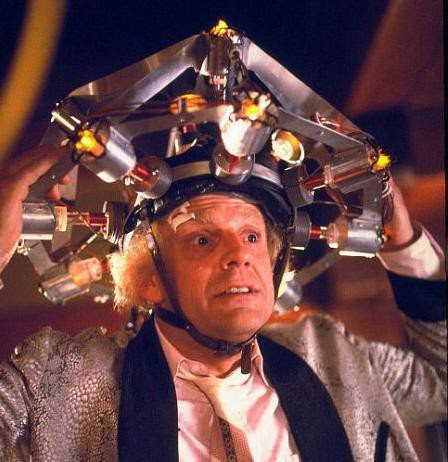
UConn's new coach is unconventional but effective

Back to the Future Cinematography by Dean Cundey

Connecticut: A Time Machine

What do you get for the team that has everything? The Huskies aren't just a 1-seed, they're the overall number one team in our current S-Curve. They are the only team in the country ranked top-5 in the averages of both Resume and Metric rankings. Their 7 wins against Quadrant 1+2 opponents is best in the country. So for the Huskies, Santa is bringing Special Assistant Coach Emmett "Doc" Brown, who will help speed UConn into the future. When you are beating everyone by double-digits, all you want is to get to the tourney before anyone figures out how to beat you. If the NCAA Tournament started today, UConn would be the favorite, so they want to get there as soon as possible in this exact condition.

Xavier: Long Range Attempts

Xavier is one of the best shooting teams in the country. They rank #2 in 3PFG% at a sizzling 40.9% clip from deep. They have five players shooting 39.5% or better from deep. And yet they rank #261 in the percent of points scored from long range and #306 in 3-point attempt percentage. Why on earth would they not be doing everything in their power to create as many deep looks as they can? When you're this good at shooting, you should do it a lot! Sean Miller's a smart guy, modernize that offense.

Marquette: Offensive Rebounding

It seems like the Golden Eagles' present arrived broken, with the news that Zach Wrightsil will miss the rest of the season. This is a tourney team that is outperforming expectations on both ends, but their lowest offensive and defensive rank in the Four Factors is rebounding on both ends. Looking at Coach Smart's best teams, every time he finished in the top-30 of kenpom, his teams were better than bad on the offensive end, averaging 98th nationally in offensive rebounding percentage. Without Wrightsil, they'll need it to emerge from somewhere else, so hopefully Santa has a backup plan since the expected rebounder won't be back.

Did motion sickness lead to Creighton's losing streak?
 

Creighton: Dramamine

The Blue Jays don't seem to handle travel very well. Per T-Rank, they were ranked #17 overall through their first 7 games, including their runner-up finish in Hawaii. Then they flew back to the mainland, and clearly the travel didn't suit them well. They plummeted to #120 after they got back as they lost their next five games, punctuated by an 0-1 Big East start at the hands of Marquette. Hopefully the Dramamine will help them with the motion sickness that saw their offense go from #10 to #262. Settle your stomachs, hope that Kalkbrenner has kissed his illness goodbye, and get a win for Christmas against DePaul.

Butler: A Bench

Butler's starting five looks like an NCAA Tourney team, but they rank #362 out of 363 in terms of bench minutes. Whether it's the injuries that kept out Ali Ali and Jalen Thomas early or Myles Tate and DJ Hughes recently, Thad Matta has had only one bench player available for all of their games, freshman Pierce Thomas. The Big East season is long, and while you want your best players ready to go in March, you need some depth to get there. Hopefully Santa brings health to a bench that desperately needs it.

Providence: Laser surgery for Jared Bynum

Last year, Providence had respectable three-point shooting largely thanks to Bynum being the best marksman in the league at 41.3% from deep. This year, he's hitting just 20.4% from beyond the arc. Bynum needs a trip to the eye doctor so he can get his vision and shooting corrected. The first sign their Christmas wish might come true was his 3/8 (37.5%) performance in the double-overtime win over Marquette, representing season-highs in both makes and attempts from deep for the Friar guard.

Seton Hall needs help holding on to the ball
 

Seton Hall: Stickum Spray

With a 22.1% turnover rate, the Pirates turn the ball over a lot. They have five different rotation players that have individual turnover rates over 20%. Santa needs to help them learn the value of possessions, and if they can't do it on their own, spraying Stickum on their hands might help them keep a tighter grip on the ball. It wouldn't necessarily fix their shooting, but let's focus on one improvement at a time.

St. John's: A Meaningful Non-Conference Win

While some brackets have the Johnnies in, they wouldn't be close to the NCAA field if the tourney were held today because they didn't beat anyone of note in non-conference play. While they have a trio of high major wins, Nebraska at home and Syracuse on a neutral are both Quadrant 3 wins, while their neutral court wins over Florida State and Temple register as Quadrant 4. Right now, the only bubble St. John's is close to in the NIT bubble because they haven't beat anyone that mattered.

Villanova: Justin Moore

Last year, Moore ranked #2 in kenpom's Big East Player of the Year metric and was the highest returning player, but he's been kept out due to injury. After a miserable 2-5 start, Cam Whitmore arrived with St. Nick to propel 'Nova to a five-game winning streak, but to get back into NCAA contention they need to be better than their #56 T-Rank since Whitmore's return. A healthy Justin Moore would give them another athletic switchable defender who knows the system. He's also a proven offensive contributor for a team lacking a true go-to scorer. To become the Villanova of old, they need an old Villanova player, and Moore fits the bill.

DePaul: A StubHub Login

The Blue Demons are 0-5 against Quadrant 1+2 opponents and their most recent loss was by approximately a bajillion points on the road at Northwestern. The only way they're going to attend postseason games is if they pay for the privilege, so Santa can let them use his StubHub login to buy tickets to any NCAA site they choose.

Rick Pitino would be an immediate upgrade on the Hilltop

Photo by Joe Robbins | Getty Images

Georgetown: Rick Pitino

It's hard to imagine things got this bad for Georgetown. They haven't beat a high-major team since December 11, 2021 (Syracuse) and haven't beat a Big East team since March 13, 2021 (Creighton) in the improbable Big East Tournament Final. This team desperately needs new leadership. Patrick Ewing is clearly not the guy, so let's give them someone who knows the Big East, who knows how to coach, and who Casual Hoya has been asking for all season long. Let's give them the gift of Rick Pitino. He might not last long as he's getting up there in the years, but he's won everywhere he went so it's worth taking a chance on an upgrade.

With Santa's work done, let's look at the S-Curve:


And, as promised, here's the full NCAA bracket. For Marquette fans, they begin their run in Birmingham against Oklahoma, followed by a likely match with Kelvin Sampson's Houston team if they manage to make the second round.

 
NIT 1-Seeds: Utah State, TCU, NC State, Rutgers
NIT 2-Seeds: Butler, Colorado, Oklahoma State, Providence

Multibid Leagues

Big 10: 10

Big 12: 7

SEC: 7

ACC: 5

Big East: 4

Pac-12: 4

Mountain West: 4

American: 2

WCC: 2

Monday, December 19, 2022

Starting the Big East off right

#mubb is 1-0 in Big East play with a convincing win over Creighton. We're back to talk about the results of the Creighton and spend some time analyzing Oso Ighodaro's performance to date. We then turn to the next two games on the season, on the road against Providence and home just after Christmas for Seton Hall. We talk about whether or not Marquette can start the Big East as 3-0. Last pod before Christmas so Merry Christmas to all and to all, ENJOY! https://mcdn.podbean.com/mf/web/nsj7n9/ScrambledEggs_Editted_121922.mp3

Wednesday, December 14, 2022

The one where we heap praise on Kam Jones

The book on non-conference season has been closed and the first chapter in conference season is about to start so #Scrambled Eggs is here to do the book reivew. We start with a discussion of the general butt kicking that took place in South Bend over the weekend. We then talk about what a revelation Kam Jones has been so far this season and whether we can see that continuing through the rest of the season. We then turn to previewing the Creighton match-up, how much Kalkbrenner means to them, and whether we think #mubb can get the win on Friday evening. We also get a little carried away at the end of the podcast talking about the future, but hey, it's the holidays we can dream. As always Enjoy! https://mcdn.podbean.com/mf/web/qsfk4z/ScrambledEggs_Editted_121322.mp3

Monday, December 05, 2022

Unbiased Data & the Big East

Sanogo is an All-American Batman with an able Robin in Jordan Hawkins

Photo by Ian Bethune | The UConn Blog

Savvy college basketball fans may have noticed that Bart Torvik's T-Rank site allows you to sort teams by using only this season's data. Typically, advanced metrics such as T-Rank, kenpom, Sagarin, and others use historical data at this point of the season because the generally accepted knowledge tells us that the best predictor of future results is looking at past results, both in terms of programs and players. This old data is usually part of the equation until late January, when sites catch up to the current year alone. If kenpom (or T-Rank with old data), you're looking at a small helping of what's happened this year with additional portions of multiple past seasons.

If you really want to know how teams have been without past seasons biasing the results, changing one factor on the T-Rank main page allows you to do that. Simply change the "End" date to anything earlier than the listed "20230501" (May 1, 2023). You can bring it all the way back to today, but even changing it to April 30 will get the desired result. So what does the data tell us? Let's take a look at where the teams come in nationally, within the Big East, and in terms of Adjusted Offensive and Defensive Efficiency rankings.
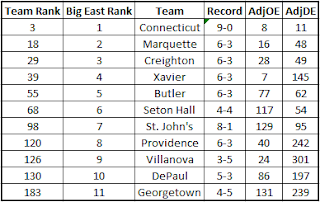

Not surprisingly, UConn jumps to the top of the league, as they have in all the metrics and rankings, but in a more pronounced way. Marquette has been the second-best team in the league, while Creighton and Xavier are in the top-40 area that is usually safe for high-majors to get at-large bids. If this was Selection Sunday, Butler and Seton Hall are in the bubble range, while the rest of the league wouldn't be close to the at-large discussion. Though while the bottom is bad, it's worth noting that Georgetown is in a class by themselves. They are truly awful.

First, let's talk about a couple league takeaways.

Bids are Limited: No one wants to hear it the first week of December, but the Big East is going to have a hard time getting more than 5 NCAA bids, and 3-4 is probably a more realistic number. Why? Because everyone that isn't UConn or St. John's has taken multiple losses, and St. John's 8-1 looks like a sham. We'll get to that later. Going a combined 7-11 in the Gavitt and Big 12 Challenge series hurt the league compared to their high-major peers, and while Connecticut and St. John's won their MTEs, Creighton was the only other team with a winning MTE record. The other eight teams went a combined 5-16 in MTEs. Overall, the Big East is 15-25 against the other high-major leagues with 8 losses outside those leagues. That's going to make it tough come March because quality wins are hard to come by when few teams proved to be potent in the first month of the season.

Four Tiers: I know the AP has Creighton at #7 until the new poll, but UConn has been in a class of their own. Based on this year's numbers, they are a legitimate Final Four and National Title contender. After that, Marquette and Creighton, despite their non-con slip-ups this weekend, are playing like solid tournament teams. Then there's Xavier, Butler, and Seton Hall as at-large contenders while everyone else looks like NIT at best. There's certainly time for things to change, but at this moment, you don't want to be a St. John's, Providence, or Villanova because none of them are close to sniffing a bid, unless you count the NIT.

Is This Meaningful? Last year at this point, Marquette was 7-2 but their overall efficiency was #118 in T-Rank. There's time for teams to turn this around, especially teams with winning records. But with close to a third of the season done, this also isn't a small sample size. On December 5, 2021, Villanova (#5), Xavier (#20), UConn (#30), and Seton Hall (#31) were in the safe range where at-large teams are typically picked and 3/4 made the NCAA field. Providence (#151), Creighton (#101) and Marquette were outside that range, but managed to put together solid finishes to the season. A month into 2020, the only three Big East 2021 at-large teams were Villanova (#14), UConn (#15), and Creighton (#16) while everyone else was already outside the top-40. If you're outside the safe range with a decent record, there's time to turn things around.

We're also going to look team-by-team and compare what we said in the preseason to what's happened since:

Connecticut

What We Said: "They should finish in the top-half of the Big East and earn a tourney bid, but whether Sanogo is a legit BEPOY contender, whether the returners deliver on their promise, and how well the newcomers fit in will determine the difference between a possible protected seed and a team closer to a double-digit seed."

What We've Seen: The Huskies backed up their buy game beat-downs with four straight wins over high-major opponents by double-digits. Sanogo doesn't just look like a BEPOY contender but the prohibitive favorite and an All-American. Jordan Hawkins has looked like a star, Andre Jackson is rounding into form, and their newcomers are fitting well. Based on this year's numbers, only one team in the country is ranked in the top-15 both on offense and defense in T-Rank, and this is that team. UConn is the clear Big East favorite to date. It's not close.

Marquette

What We Said: "If this team stays healthy, sustains their defensive form, and is marginally effective on offense, they should be fighting for an NCAA berth. And if one or two players really break out, the way Lewis and Morsell did a year ago, there's no reason they can't be a top-4 Big East team and in the mix for a safe single-digit seed."

What We've Seen: The defense is about on par with last year but the offense has been way ahead of schedule. Kam Jones and O-Max Prosper are having star turns while plenty of other players have shown the ability to step up, which puts this team in the mix for the 2-4 range we thought was possible. We do need to caveat that these numbers are likely heavily impacted by the Baylor romp, but no one has played undefeated Purdue or Mississippi State closer than Marquette, so even the losses right now aren't as bad as the raw percentage looks. Putting aside the sour taste of the Wisconsin loss, this year's results alone indicate Marquette to be the biggest threat to UConn at the top of the Big East at this point.

Prosper is having a Justin Lewis type breakout season

Photo by Jeff Haanisch | USA Today

Creighton

What We Said: "While the Kansas game left Jays fans on a promising note, last season's results as a whole, the need for so many players to have simultaneous breakout seasons, and the expectation of defensive consistency from a coach that has never shown an aptitude for that would strongly indicate they won't get close to those top-10 projections. There's a reason none of the computer metrics have Creighton in the preseason top-20."

What We've Seen: At their best, Creighton has looked like that top-10 team, putting on a show in Maui. At their worst, they struggled with St. Thomas, were beat down at Texas, and lost at home to a mediocre (#76 adjusted for this year) Nebraska team. Sure, they can be that team they were at the Big East Tournament, but they still have tendencies from the team that T-Rank had #71 last year going into the BET. This is a good team, but this year's data shows the defense regressing, the offense not quite at the level McDermott is known for, and a team more like the fringe top-25 team we expected than the juggernaut their fans thought they were.

Xavier

What We Said: "But if they can figure out how to get the ball inside and Miller can put out two-big lineups that work on the defensive end, this team is a threat to win the Big East and make the second weekend of the NCAA Tournament. Don't sleep on Xavier, if it all comes together, they are the team to beat in the Big East."

What We've Seen: Miller has managed Freemantle and Nunge on offense, but defensively this team just isn't there yet. They don't rank in the top-100 on any of the defensive Four Factors (eFG%, Turnover Rate, Rebound Rate, Free Throw Rate). The biggest problem has been the inability to close out games, losing winnable games against Indiana and Gonzaga while getting close but not quite against Duke. This is still pretty clearly a top-half Big East team and NCAA bid contender, but not as good as we thought they could be so far.

Butler

What We Said: "If everything comes together and they hit their peak, this could be a tourney team come March. Expect them to land in the middle of the Big East, somewhere in the 6-8 range where they spend the season bouncing around the bubble."

What We've Seen: This one feels prescient. Chuck Harris has been a star, Manny Bates is a monster, and the pieces fit together well. They're not great on either end of the floor, but good enough to fight for a bid with no really bad losses and a couple decent wins. Their position at fifth in the league is a little ahead of expectations, but that's more a product of bad Big East teams than them overachieving what we saw coming.

Manny Bates is driving a resurgent Butler

Photo from Butler Athletics

Seton Hall

What We Said: "The Pirates will have a tough defense that gives them a shot to beat most of the teams they face. But it's hard to see who will be the shot-makers that push them over the edge when a game is tight down the stretch. I've seen some people touting this as a tourney team, but that feels like projection based on last year's improbable St. Peter's run. There just isn't enough offense here to get to the postseason."

What We've Seen: The offense is indeed bad. Al-Amir Dawes has been okay but turns it over too much, Tyrese Samuel is great on the offensive glass but can't create for himself and no one else can create for him either, and KC Ndefo is as bad as expected on offense. The defense has kept them in some games and the combination of the two has them far ahead of our overall expectation (we said only ahead of DePaul and Georgetown). This isn't a NCAA tourney team at this point, but it's not unthinkable and the NIT is certainly within reach. If they can improve their offensive efficiency and Kadary Richmond can become an actual game manager they could fight for a bid.

St. John's

What We Said: "Expect the Johnnies to finish in the bottom half of the league once again. If all breaks right and Curbelo and Jones have transformative seasons, they may find themselves on the right side of the bubble, but more likely this is a team that will be playing in the NIT, hoping to end their season at home in MSG."

What We've Seen: Don't be fooled by the 8-1 record, this has not been a good basketball team. They beat Nebraska at home for their best win, but narrow wins over poor Temple (#86) and Syracuse (#134 in OT) teams aren't what NCAA resumes are made of. They lost their only meaningful game at Iowa State. This looks like another classic Mike Anderson team that goes 9-2 in non-conference play, mostly beating up on weak opposition, then sputters to a 7-13 Big East mark but the 16-15 overall is enough to maintain his non-losing record streak and put them in the NIT mix.

Providence

What We Said: "If all goes well, they'll be on the right side of the bubble, if not they'll likely be in the NIT, somewhere in that 6th-9th in the Big East range that looks like a throw of the dice at this point of the season."

What We've Seen: While the 6-3 record matches Marquette, Creighton, Xavier, and Butler, the substance is vastly different. Their 3 losses are to the only top-100 teams they've faced, and all three in ranked lower than 50 for the current season. Not the worst losses, but not good. And their best win was the season opener over now #239 Rider. With two buy games left against sub-300 teams, the non-con resume is trash. Cooley has turned it around in conference play before, but in a down Big East, Providence will likely need to win 13-14 Big East games just to get in the at-large discussion. Last year's Marquette turned it around with a monster January. Providence will likely need the same, but it's a tougher task this year because last year's Big East was a much stronger league so there were more resume boosting opportunities.

Villanova

What We Said: "Neptune was left a great roster but keeping them healthy and getting the freshmen to blend in will determine how far this team can go. On paper, they should be a league title contender and if not the champs, certainly in the top three. But if they can't overcome their injuries, they could be closer to the bubble."

What We've Seen: We were way off on Villanova. Freshman Mark Armstrong wasn't ready, Chris Arcidiacono has been an every game starter, and there's no consistent point guard play. Despite that, the offense has been passable thanks to Caleb Daniels and Eric Dixon carrying heavy loads efficiently. The defense, on the other hand, good God. In twenty-one seasons at Villanova, Jay Wright only one one sub-100 defense, and that was the 2011-12 team that ranked #132. That was the floor. In his first year, Kyle Neptune has jackhammered through that floor, through the basement, and replaced the foundation with dirty sponges soaked in anchovy juice. They are ranked an absolutely abysmal #301. That is the worst of any high-major team, a full 54 spots behind 0-9 California. 'Nova fans will hope that Cam Whitmore and a possible Justin Moore return can turn things around, but at this point Villanova isn't even in the NIT mix, much less contending for the bubble. The drawback, like it is for Providence and St. John's, is they are out of meaningful non-con opportunities and a down Big East makes it harder to climb up the seed list as the season goes on.

Villanova hopes Cam Whitmore will drive them back into NCAA contention

Photo by Matt Slocum | AP Photo

DePaul

What We Said: "DePaul was one of the worst teams in the league, so if the new pieces come in and equal them, this is still a bad team. It must be hard to find optimism in Chicago when the best case scenario looks like bottom-3 in the league and there's a good chance 6 starters or rotation players will be gone at the end of the year."

What We've Seen: At a cursory glance, there seems to be reason for optimism. Umoja Gibson, Javan Johnson, and Eral Penn have been high efficiency offensive players while none of the major pieces have been bad. Those numbers may be a bit of fool's gold, however, as DePaul has only faced one defense ranked inside the top-100 and they lost to Oklahoma State. They've lost or gone to overtime with three sub-100 teams already and their defense, while not Villanova-bad, hasn't been good. If these guys can keep up their efficiency in conference play and they win the rest of their non-con matchups (including a trip to Northwestern) they could be an NIT team. More likely, however, it's just DePaul. They'll be in the bottom-3 and every player mentioned by name in this paragraph is ineligible to return beyond this season.

Georgetown

What We Said: "It's hard to fire a legend, but if Ewing couldn't make a tournament with James Akinjo, Mac McClung, Jessie Govan, Josh LeBlanc, and Jamorko Pickett, why would anyone trust him to do it with this cobbled together roster of role-players and losers, at least in terms of record? If they make it to tenth in the Big East, it should be considered a massive accomplishment, but still shouldn't be enough to save the job of the worst coach in the league."

What We've Seen: Their season opener was better than last year, as an overtime win over lowly Coppin State is still better than a loss to Dartmouth. That was probably the high point of the season. They haven't beat a team in the top-200 and have three sub-100 losses. Ewing just threw his entire team under the bus, saying "This isn't the NBA where you can trade and get other players in" despite the facts that thus far, he has seven players that have started a game for him this year, those seven are the only players to average 10 minutes per game, and NONE of them were on the roster last year. Meanwhile, of the nine players that started a game last year, this weekend's transfer by Dante Harris means only one is still left and that's Ryan Mutombo, who started just one game, has played 29 minutes this year with 4 DNPs, and hasn't been deemed important enough to play a single minute in three games against high-majors this year. Ewing did trade his roster and it still sucks. As far ahead of the rest of the league as UConn is, Georgetown is even further behind the next worst teams and until Patrick Ewing is fired there is no end in sight.

Sunday, December 04, 2022

It was a solid week, just not an amazing week

Well #mubb fans, it was good, but it could have been amazing. We're going to work from bad to great so we'll start with the Wisconsin game result. We talk about the OT loss to Wisconsin, how much it hurts, and what it didn't go the way we all hoped. We also talk about some of the individual plays and players and how we may extrapolate for the rest of the season. We then revisit the amazing win against Baylor and how that happened. With the week that was covered, we turn to the week to come which includes a maturity tester of a buy game and a catholic Sunday fight against Notre Dame. We also spend a little time talking about how we see the balance of the season going. It's a wide ranging 2 drink minimum podcast so spend some time with us and enjoy! https://mcdn.podbean.com/mf/web/trh7jm/ScrambledEggs_Editted_120322.mp3