#mubb fans, it is that most wonderful time of year again, BADGER HATE WEEK. Before we get to that, we have to talk about a few things. First, we want to talk about the week that was where MU went 2-1. We talk about the loss at Mississippi State and what we've learned about this team and the Big East so far. We then preview the Baylor game (and implore you to attend) and talk about what MU's path to an upset victory looks like. Finally, we turn to the red menace, and talk about how this year, even more than most years is a shocking contract in styles. https://mcdn.podbean.com/mf/web/inhh62/ScrambledEggs_Editted_112822.mp3
Monday, November 28, 2022

Sunday, November 20, 2022
Win some you lose some, but during Feastweek everyone wins
We're back for another week of #mubb discussion including the first challenging game of the season. We spend the beginning of the pod highlighting the success of both the Women's basketball program and Volleyball program. We then turn to focus on the results of the Purdue game, what we liked and what leaves us with concerns. Finally we pivot to upcoming FeastWeek (3 games!) and talk about what the week looks like for MU. Happy Thanksgiving and Enjoy! https://mcdn.podbean.com/mf/web/cs4x4j/ScrambledEggs_Editted_111922.mp3
Friday, November 11, 2022
This was a good week, Jopwagon edition
The #mubb season is underway and we have some things to say about it. We review the two games this week as well as discuss that surprised us in both good and bad ways. We also spend some time reviewing the Purdue game, what to expect, and what we hope happens then close out with the briefest preview of LIU possible. As always, enjoy! https://mcdn.podbean.com/mf/web/uaemny/ScrambledEggs_Editted_111122.mp3
Sunday, November 06, 2022
Marquette Preview, 2022-23
Marquette Golden Eagles
Head Coach: Shaka Smart (19-13 at Marquette, 291-155 overall)
Three-Year NET Average: 56.3
Three-Year kenpom Average: 56.7
Projected 2022-23 T-Rank: 70
Projected Starters: PG Tyler Kolek (6'3" Jr), SG Stevie Mitchell (6'2" So), SF Kam Jones (6'4" So), PF Olivier Maxence-Prosper (6'8" Jr), C Osasere Ighodaro (6'9" Jr)

Tyler Kolek looks to lift Marquette to new heights
Photo from Marquette Athletics
Expectations were pretty low for Marquette in Shaka Smart's first year, with the team picked 9th in the Big East and outside everyone's NCAA Tournament projections. The early season was highlighted by a win over then #10 Illinois. While the team suffered through a 1-5 December thanks to a brutal schedule, they rebounded to win 7 in a row in January, including becoming just the second Big East team not named Villanova to win at the Finneran Pavilion and the first Big East team to sweep Villanova since 2017. That was the high, the low was a 3-6 finish, including losses to open both the Big East and NCAA Tournaments. While the team overachieved, it was a disappointing finish that guaranteed a ten-year NCAA tourney win drought for both Marquette (March 28, 2013 over Miami) and Shaka Smart (March 21, 2013 over Akron). Compounding the ugly finish, leading scorer and rebounder Justin Lewis declared (and went undrafted in) the NBA Draft while starting seniors Darryl Morsell and Kur Kuath exhausted their eligibility.
The strength of 2022-23 Marquette looks to be the back court. Tyler Kolek was the Big East assist leader, winning over fans with his visionary passing and trash talking. They are hoping he'll improve his scoring, where his 40.0 eFG% simply wasn't good enough. Kam Jones looks most likely to take the alpha scorer mantle. This team will likely score by committee, but Jones is the guy who is most likely to get double-digits on any given night and is one of the best returning shooters in the league at 39.2% from deep. His improvement needs to come inside the arc, where he struggled with contact and didn't draw a single free throw in league play. O-Max Prosper is the other incumbent starter. He's a long, athletic defender who takes valuable seconds off the shot clock with his one man press. Marquette will need him to be more aggressive both in terms of hunting his shot and particularly in attacking the glass. Oso Ighodaro might be Marquette's most important player, simply because there are so few options behind him. He's a capable low-post scorer and savvy passer for a big man who Shaka says will play extensively with the ball in his hands. The last starter feels like an open question, with perimeter defensive ace Stevie Mitchell, high-ceiling forward David Joplin, and NAIA Player of the Year Zach Wrightsil in the mix. For the moment, we are expecting Smart to go with Mitchell's defense. He's a very good on ball defender who provides additional ball-handing. Wrightsil is expected to be one of the first front court options. He was a tremendous rebounder and interior scorer, though it remains to be seen if it will translate up to the Big East. The biggest wildcard may be David Joplin, who has shown the kind of aggressive scoring tendencies that helped Justin Lewis shine, but who also needs to tighten up his defensive play to get the reps necessary to show that capability. Offseason reports sound like Joplin may be the player ready to break out and don't be surprised if he works his way into the starting lineup before too long, but we don't think that will be opening night. The most likely freshman to be in the rotation is Sean Jones. He's an undersized point with blazing quickness (Smart says he's the fastest player he's ever coached) and the ability to create for both others and himself. Three other freshmen have a chance to crack the rotation; Chase Ross is an athletic but raw wing, Ben Gold is a 6'11" stretch forward whose shooting can create mismatches, and Keeyan Itejere is a high level athlete with size but maybe not enough polish yet to reliably platoon with Ighodaro.
Offensively, Marquette runs a lot of pick and roll, with the goal being to get open looks from three or shots at the rim. If players are solid in the midrange, the coaches will encourage those shots, but last year Morsell and Lewis were the only two that seemed to have much freedom in that regard. Kolek will likely lead the way with drives, seeking to either dump it off to Oso once he draws the defender or kick it out to an open shooter. Smart has also talked a lot about Ighodaro playing with the ball in his hands and becoming more of a distributor from the low post. On defense, despite what pundits like to say this is not the Havoc Smart ran at VCU. That system was a highly aggressive full-court press designed to turn teams over at all costs. His Violence defense is different. The real focus here is on time. Whereas the offense plays lightning fast (15.1 seconds per possession was #5 nationally) the defense does whatever they can to slow down possessions (18.3 seconds, #326). They often run a press, but it's designed to take seconds off the shot clock and shorten the time the offense has to get into their sets once they cross half court. They have recruited a number of long, athletic players that can switch and apply pressure all over the court. Last year they had a safety valve with the elite shot-blocker Kuath at the back. Ighodaro isn't as prodigious a rim protector so he will have to be better positionally. This may be where Itejere can help as he has the athleticism, but he's very raw so his minutes may be limited particularly once conference play begins.
Marquette seems to be a mystery this year. Many have pointed out that none of these players scored in double-digits last year for D1 programs, but last year Kolek was the only player on the roster who had scored double-digits at the D1 level previously. That didn't stop Lewis and Morsell from blossoming into consistent offensive options. In our Who Will Score? series earlier this summer, we learned that losing volume scoring is not closely correlated with a loss in team offensive efficiency. And in terms of volume, there's enough options that there will likely be numerous players around double-digits. Marquette lost 56.1% of their scoring, but last year, offense was never really the problem. When the team fell apart late, it was the defense that caved in. Per T-Rank, from the start of the season through February 3rd, Marquette's defense was ranked #35 nationally. From February 4th through the end of the season, it was ranked #177. The team's collapse was almost entirely because of defensive issues. If you want to worry about this team, I would point you toward the excellent Paint Touches article that points out the impact of Lewis, rebounding issues, and youth, among other concerns. Those concerns are legitimate. However...
This Marquette team also returns two more starters than it did a year ago. It returns four players that were significant contributors to last year's team, which is four more than they had a year ago when they surprised everyone with an NCAA bid. In terms of age, this team is young, but in terms of experience they are light years ahead of where they were a year ago. Last year was the first time in 11 years that Smart didn't have a top-40 defense, and it stands to reason with a more experienced roster he will once again have a top-40 defense this year. Offensively, Smart has had 10 teams rank in the top-100 per kenpom. 8/10 earned NCAA bids and the other two both won second tier tournaments (CBI in 2010, NIT in 2019). In the preseason, this team beat Loyola-Chicago in a scrimmage comfortably behind 27 points from Kam Jones while David Joplin's 28 points led the way over Missouri. If this team stays healthy, sustains their defensive form, and is marginally effective on offense, they should be fighting for an NCAA berth. And if one or two players really break out, the way Lewis and Morsell did a year ago, there's no reason they can't be a top-4 Big East team and in the mix for a safe single-digit seed.
Saturday, November 05, 2022
Xavier Preview, 2022-23
Xavier Musketeers
Head Coach: Sean Miller (120-47 at Xavier, 422-156 overall)
Three-Year NET Average: 48.7
Three-Year kenpom Average: 54.7
Projected 2022-23 T-Rank: 20
Projected Starters: PG Souley Boum (6'3" RS Sr), SG Adam Kunkel (6'4" RS Jr), SF Colby Jones (6'6" Jr), PF Zach Freemantle (6'9" Sr), C Jack Nunge (7'0" RS Sr)

It's Jones on Jones as Xavier's Colby lifts a floater over Marquette's Kam
Photo by Katie Stratman | USA Today Sports
2021-22 was the best of times and worst of times for Travis Steele and the Xavier Musketeers. They opened the season 11-1, and pushed that to 14-3 and a #17 AP Poll ranking despite a tough pair of losses to Villanova. Then the cracks started to show. They alternated winning two, losing two, winning two, and losing two before notching a win over UConn that had them 7-6 and still looking like a comfortable NCAA team. Then it all fell apart as Xavier lost 5 straight, managing only a win over Georgetown before bowing out to lowly Butler in the Big East Tournament opener. Steele found himself four years into his tenure with zero NCAA appearances. After struggling with Cleveland State in the first round of the NIT Tournament, Steele was fired. Typically, that would end the story, but Xavier played on, led by assistant Jonas Hayes, who was a perfect 4-0 en route to a NIT title when they defeated St. Bonaventure and Texas A&M at Madison Square Garden. That run landed Hayes the Georgia State job, as the back court trio of Paul Scruggs, Nate Johnson, and Dwon Odom all left.
If not for Jay Wright's retirement, Sean Miller's return to Xavier was the story of the offseason. In his first stint at Xavier, Miller went to four straight NCAA Tournaments with trips to the Elite Eight and Sweet Sixteen. He left for Arizona, where he had five second-weekend runs with the Wildcats, going to two Sweet Sixteens and three Elite Eights. Despite being involved in the ongoing FBI cases, Miller is regarded as an elite recruiter and game coach. In his seventeen seasons as a head coach, he's had nine teams finish in kenpom's top-20 and two of those were top-5 teams. He returns to Xavier with a talented roster. That starts in the front court, where Jack Nunge and Colby Jones were both preseason All-Big East selections. Nunge blossomed at Xavier, posting career highs in scoring, rebounding, blocks, and three-point percentage while having the lowest returning turnover rate of any player in the league. He's a viable Big East Player of the Year candidate, alongside obvious contenders like Adama Sanogo and Ryan Kalkbrenner, and also one of his teammates. Jones hit his apex in the NIT, averaging 14.8 ppg/6.0 rpg/4.4 apg while winning MVP of the NIT. Also in the front court is Zach Freemantle, who had a bit of a down year after his brilliant 16.1 ppg/8.9 rpg season in 2020-21. Freemantle had some off-the-court issues this summer, but it sounds like those were quickly resolved. If there are any questions, they are in the back court. UTEP transfer Souley Boum is expected to man the point. He was more of a combo guard at his last stop, but can create shots for himself and thrives both from the perimeter and attacking the rim. Adam Kunkel will likely be the other starter. He was a star at Belmont, but has been more of a rotation player with the ability to occasionally go off for big scoring nights. The first two off the bench are expected to be freshmen Desmond Claude and Kam Craft. Both project as shooting wings, with Claude considered the more skilled of the two and a possible point guard option if Boum isn't up to the task. There have been quiet raves about Claude as a future NBA player, so keep an eye on him as a possible All-Freshmen honoree if given the chance. In the front court, keep an eye on Dieonte Miles and former Indiana transfer Jerome Hunter, both of whom are expected to get minutes in multiple big man sets.
Offensively, this team has the potential to be devastating. All five starters can score from deep, they are all sure-handed with the ball, and Nunge/Freemantle/Jones might be the best offensive rebounding trio in the league. Miller's teams thrive at applying pressure, attacking inside, scoring, and getting to the line. His teams are often reticent to take threes, but when he has shooters his offenses tend to be elite, and this team has shooters. On defense, Miller has historically run pack line. His best defenses have multiple shot blockers (like Nunge and Freemantle), clog the interior, and try to bully opponents on the glass.
In terms of proven talent, Xavier deserves to be considered one of the favorites to win the Big East. Miller is a fantastic coach, he has a pair of bigs that have demonstrated high-level production, and a potential breakout star in Jones. But there are also question marks. Who will get the ball to the bigs? There might not be a true point guard on the roster and this team will need to get it inside. Defensively, can Freemantle and Nunge coexist? While both have the size and ability to be a defensive backstop, neither are the quick-footed type to get out on shooters when the opponent has forwards that stretch the floor. An inability to answer questions like these are the reason Travis Steele lost his job. And while Miller's best teams have been elite, he's had issues when his guards don't share the ball enough and there's big man overlap. The floor for this team should be the NCAA Tournament. They are simply too talented and Miller too good to miss. That said, they have been struggling in their preseason play, losing to Vanderbilt in a scrimmage and struggling with Kentucky Wesleyan in an exhibition. That could be working kinks out or it could be signs that the roster construction issues aren't a one-year fix. But if they can figure out how to get the ball inside and Miller can put out two-big lineups that work on the defensive end, this team is a threat to win the Big East and make the second weekend of the NCAA Tournament. Don't sleep on Xavier, if it all comes together, they are the team to beat in the Big East.
Marquette Memory: Two overtime losses for Marquette form interesting bookends. George Thompson scored 41 points on February 26, 1968, in an 88-83 loss at Xavier. On February 22, 1984, Xavier again defeated Marquette in overtime, this time 82-68. In between Marquette went on an incredible 26-game winning streak over the Musketeers. Not only was the streak impressive, but Marquette won those games by an average of 18.8 points per game, with none of the contests closer than an 8-point margin. That streak is the second longest winning streak over a single opponent in Marquette history, exceeded only by the ongoing 39-0 mark Marquette has against UW-Milwaukee.
Friday, November 04, 2022
Want to know how the #MUBB season will go? Listen up!
Once more lord #mubb rises from its slumber and brings joy and pain to the MU faithful (hopefully more joy than pain). The season starts Monday so we're back to make all sorts of predictions on how the season will go. We look back on season predictions of years past so you know how much to ignore us this season. Then we go game by game calling our shots, #DLTD is back in full effect. We close the podcast out with some player and lineup predictions. All in all, we are pumped for the start of Season 2 of Shaka's World. Enjoy! https://mcdn.podbean.com/mf/web/9f9xkr/ScrambledEggs_Editted_110422.mp3
Villanova Preview, 2022-23
Villanova Wildcats
Head Coach: Kyle Neptune (0-0 at Villanova, 16-16 overall)
Three-Year NET Average: 10.0
Three-Year kenpom Average: 13.3
Projected 2022-23 T-Rank: 17
Projected Starters: PG Mark Armstrong (6'2" Fr), SG Caleb Daniels (6'4" RS Sr), SF Cam Whitmore (6'7" Fr), PF Brandon Slater (6'8" RS Sr), C Eric Dixon (6'8" RS Jr)

Justin Moore's health could determine Villanova's success
Photo by Aaron Gash | AP Photo
The Villanova 2021-22 season was the end of the Big East reformation era. Yes, the league continues with the teams that departed in 2013 plus UConn, but it's probably easy for fans who've come to rely on this new basketball-first league and fans who weren't old enough to be invested in the 2000s version of the league to forget just how tumultuous the years before and after the Catholic 7 split were. The Big East had 11 NCAA bids in 2011, and just three years later didn't even have 11 members. And while most expected Marquette and Georgetown to carry the flag for the year, certainly in light of their then-recent successes, it was Jay Wright and Villanova who first established themselves as a regular season juggernaut, then won two titles to lift the league back to the apex of college basketball. In what became his final season, Wright got off to a shaky 7-4 start, culminating in back-to-back 20+ point losses to Baylor and Creighton. Then they turned it around, going 16-4 in league play and winning the Big East Tournament before once again marching to the Final Four. If not for an injury to Justin Moore in the Elite Eight, it might have been Wright cutting down the nets one more time, but instead they bowed out to eventual National Champions Kansas and Wright quietly retired a couple weeks later.
Kyle Neptune returns from a year at Fordham and takes over a roster that is very talented but also in flux. For the past decade, perhaps no program has had more consistency at the point guard position than the continuity of Ryan Arcidiacono, Jalen Brunson, and Collin Gillespie. Top-50 freshman Mark Armstrong is the most talented option, but don't be surprised if they give some run to redshirt freshman Angelo Brizzi or experiment with sophomore Jordan Longino. One place they feel confident is at the other guard, where Caleb Daniels has developed into a reliable contributor. He's a solid second scoring option and reliable shot-maker. The biggest talent on the roster is freshman Cam Whitmore. While he's a phenomenal athlete who was one of the best players at the 2022 FIBA Americas U18 Championship, he recently had thumb surgery that is expected to hamper the start of his season. Brandon Slater and Eric Dixon will man the front court. Both are stout defenders that can step out and hit shots, but neither are first-line offensive options. The real wildcard is Justin Moore. He averaged 14.8 ppg/4.8 rpg last year and was expected to be the leader of this team before an injury set him back. There has been talk about Moore returning for the start of conference play. A fully healthy Moore could turn Villanova into a Big East title favorite, but without him it's hard to know who will step up as the offensive leader.
Offensively, this will likely be the same Villanova conceptually with a bit of flair. Expect them to be patient, share the ball, and limit turnovers. Villanova works more in concepts of knowing where to go, how to move the ball, and when to make one more pass to get the open look. They'll run pick and roll, likely getting their best chances when they drive and dish. The difference may be in pace. Neptune played faster at Fordham than Wright typically did at Villanova, while even Wright with his talented 2018 team was willing to turn up the pace a bit. Don't be surprised to see a slightly faster tempo this year. Defensively, Nova is primarily a man team that mixes in a little zone from time to time. The interior is the strength of their defense, and despite being a bit undersized, Dixon uses his strength well to deny offensive players down low. This isn't a team that will beat you by blocking shots or forcing turnovers, they will simply guard diligently. The last two years, they were willing to get into shooting contests, which is a risky proposition if the opponent starts hitting.
So what is Villanova this year? So much comes down to health. Moore is a Big East Player of the Year candidate if he's fully healthy, but considering his injury he was originally expected to miss the entire season. Whitmore has all-league upside, but no one knows when he will be 100%. Longino and Brizzi are in the mix for minutes but have had injury concerns of their own. If this team is fully healthy, they have the most raw talent in the league. Neptune was left a great roster, but keeping them healthy and getting the freshmen to blend in will determine how far this team can go. On paper, they should be a league title contender and if not the champs, certainly in the top three. But if they can't overcome their injuries, they could be closer to the bubble.
Marquette Memory: We don't have to think back very far when it comes to this memory. Marquette went into the Finneran Pavilion on January 19, 2022 having never won in that building, going 0-9 previously. It very much looked like that would continue after a 12-0 Villanova run put Marquette down 45-36 midway through the second half, but the Golden Eagles kept chipping away. Greg Elliott scored 11 points in a 14-5 stretch to pull the game within 1. Nova pushed it back out to 54-50, but then it was Justin Lewis time. A bullish drive ending in a layup got Marquette within two. On the next possession, he tied the game with a brilliant spin move through two defenders. Then, with the teams tied at 54-54, Marquette got the defensive stand and Lewis the rebound that gave them the chance to win the game. Tyler Kolek dribbled around the perimeter and tried to hand the ball off to Lewis, but he bobbled the exchange. Caleb Daniels dove for the ball, but Lewis managed to gather it back, step back, and nail a picture perfect three. Nova got a chance to tie, but Moore missed a clean look followed by Gillespie missing a desperation heave.
To put into perspective how unlikely and difficult that win was, Villanova came in 42-1 in conference games in that building since 2014. That 0.977 win percentage in conference play made the Finn the toughest building in the country to play in over that time period. For comparison Kansas was 69-5 at the Phog (0.932), Gonzaga was 66-5 at the Kennel (0.930), Kentucky was 64-11 at Rupp (0.853), and Duke was 64-13 at Cameron (0.831). The one loss Nova did suffer was an improbable one as well, as Butler had just a 6.5% chance of winning (per kenpom) when they trailed 49-42 with under 10 minutes to play. For Marquette, those chances were down to 4.1% when they trailed 45-36 with 11 minutes to play. Going back to those toughest venues, since January 14, 2020, the top two teams on that list in conference play are Villanova at the Finn and Kansas at the Phog, going a combined 45-2. Coincidentally, those two losses both came to the same person. Shaka Smart beat Kansas at the Phog on January 2, 2021 and Villanova at the Finn on January 19, 2022. Let's look back at Justin Lewis' winner at the Finn.
Thursday, November 03, 2022
St. John's Preview, 2022-23
St. John's Red Storm
Head Coach: Mike Anderson (50-41 at St. John's, 420-242 overall)
Three-Year NET Average: 65.0
Three-Year kenpom Average: 63.3
Projected 2022-23 T-Rank: 47
Projected Starters: PG Posh Alexander (6'0" Jr), SG Andre Curbelo (6'1" Jr), SF Montez Mathis (6'4" RS Sr), PF David Jones (6'6" Jr), C Joel Soriano (6'11" Sr)

Posh Alexander seeks his first NCAA bid with St. John's
Photo from St. John's Athletics
On paper, an 8-3 non-conference record doesn't look that bad, but as St. John's only won their guarantee games, even losing to perennial ACC bottom-feeder Pittsburgh, the Johnnies' start to the season was a bit concerning for a team many thought had NCAA aspirations. St. John's finished in the middle of the pack in the league, going 8-11 and earning the 7-seed in the Big East Tournament, but they did so almost exclusively by beating non-tourney teams and losing to tourney teams, going 7-1 against the former and 1-10 against the latter. That played to form at MSG, where they beat DePaul before losing to Villanova. Two of their top-three scorers, Julian Champagnie (an All-Big East First Team selection) and Aaron Wheeler are gone.
The most important returner is Posh Alexander. The diminutive point guard is a bulldog on defense and excellent floor general. He's the defensive tip of the spear for Anderson and thrives offensively when he's getting to the rim to both finish and draw fouls. If there's any drawback, it's his mediocre three-point shooting, where he hit just 21.7% of his attempts from deep last year. He is joined this year by Illinois transfer Andre Curbelo, who's an exciting player to watch, though not always for the right reasons. When he's on, Curbelo can be an electric scorer and provider, giving St. John's a pair of transition-oriented guards. But when he's off, he's a turnover machine whose team seems better without him. His 26.7% turnover rate last year was atrocious and Illinois went 13-1 in games he didn't play but just 10-9 when he did. While he was a coveted transfer in New York, Illinois fans were not disappointed to see him go. Montez Mathis is a solid wing defender who is adequate as a third or fourth scoring option. David Jones, transferring in from DePaul, is expected to take the Champagnie load. He certainly had some moments of brilliance last year, but when he was expected to carry the load for the Blue Demons with Javon Freeman-Liberty out, results were erratically mixed. In a seven-game stretch, he had three feast games where he averaged 22.3 points per game on 60.6 eFG% but had equal levels of famine, averaging 6.0 ppg on 19.0 eFG% in the other four. Defensively, Jones is a capable secondary shot-blocker and ballhawk, so he should fit in with what Anderson wants. Up front, Joel Soriano returns to man the middle. In his first year at St. John's, he was a high-efficiency, low usage scorer who was able to rebound on both ends and served as an excellent rim protector. Off the bench, look for Dylan Addae-Wusu and Rafael Pinzon to provide shooting and back court depth while Eshia Nyiwe and O'Mar Stanley rotate in up front.
Mike Anderson played for Nolan Richardson, then sat on a bench next to him for twenty years at two programs, so it's no surprise he's adapted Forty Minutes of Hell. St. John's comes at you in waves, flying around on the defensive end to create chaos and turnovers, then getting out and scoring in transition. Alexander embodies that as the ideal defensive leader, and they have enough depth to apply constant pressure. The question is what happens in the half-court. When St. John's didn't turn teams over, they struggled. They aren't a great man defense, give up too many second opportunities, and while they are aggressive shot-blockers, that leads to a high number of fouls and opponent free throws. On offense, this looks to be a positively god-awful shooting team. In terms of players that made 10+ three-pointers last year, they lost four of their top-five in terms of makes and Dylan Addae-Wusu is the only returning player who shot over 30% from deep. In addition, Curbelo (17.6%) and Jones (29.7%) aren't exactly marksmen so on bad nights St. John's can shoot itself out of games in the half-court. At his best, Curbelo may be able to help that as he is a creative passer who can thread needles others can't even see, but he can also fire passes into the stands and to opposing players.
St. John's looks like a team capable of competing for an NCAA bid on paper, and Mike Anderson has never had a losing season in his two decades as a head coach. Those records, however, are largely built on non-conference play. He's just 23-33 in the Big East and in his sixteen high-major seasons at Missouri, Arkansas, and St. John's he has only been more than a game above .500 on four occasions. The Johnnies' pressure will put some teams off their game and allow them to win a game or two they shouldn't, but with a player like Curbelo that chaos could work against them. This is a team that wants to play erratically, but Curbelo is a player who is at his worst when the game is most frenetic. Further, Jones is fine when the pressure isn't on him, but as noted above, he didn't always rise to the occasion in the past when DePaul needed him to be that focal point. Expect the Johnnies to finish in the bottom half of the league once again. If all breaks right and Curbelo and Jones have transformative seasons, they may find themselves on the right side of the bubble, but more likely this is a team that will be playing in the NIT, hoping to end their season at home in MSG.
Marquette Memory: Marquette fans will fondly remember the last time they saw Andre Curbelo. The Golden Eagles were competitive, holding on to a narrow 28-27 lead at halftime, but an 11-1 run early in the second half soon gave the advantage to the Illini and they pushed the lead to 58-46 with 10 minutes to play. Then Marquette stormed back, riding a 9-0 run to get it back to a single possession. It was a battle from that point, culminating with Tyler Kolek's steal and layup, on which he was fouled by Curbelo. Illinois had one last chance, but Curbelo tried to drive by Stevie Mitchell and instead turned into Kur Kuath, who stole the ball and quickly got it out to Justin Lewis to seal the victory.
Wednesday, November 02, 2022
Seton Hall Preview, 2022-23
Seton Hall Pirates
Head Coach: Shaheen Holloway (0-0 at Seton Hall, 64-57 overall)
Three-Year NET Average: 40.0
Three-Year kenpom Average: 42.0
Projected 2022-23 T-Rank: 55
Projected Starters: PG Kadary Richmond (6'6" Jr), SG Al-Amir Dawes (6'2" Sr), SF Dre Davis (6'5" Jr), PF Alexis Yetna (6'8" RS Sr), C Tyrese Samuel (6'10" Sr)

Tyrese Samuel looks to fill a massive hole in the middle for the Hall
Photo by Mitchell Layton | Getty Images
Kevin Willard's final season in Newark was quite the Jekyll and Hyde act. The Pirates started off 9-1, including a pair of wins over then top-ten teams Michigan and Texas. Around that time, rumors of Kevin Willard taking the now-vacant Maryland job started, and as Big East play began, they dropped their first two games and began conference play 3-6. The Pirates did rally to go 9-3 down the stretch, largely powered by the excellent play of Jared Rhoden. They made the tournament, but lost their opener, continuing a trend under Willard that saw them never make it out of the opening NCAA weekend as his teams went just 1-5 under the brightest lights. Rhoden left, as did microwave scorer Bryce Aiken, veteran wing Myles Cale, and mammoth shot-swatter Ike Obiagu.
The most notable change was Head Coach Shaheen Holloway, the former Hall star that is fresh off an Elite Eight run with lowly St. Peter's. Everything they do will start with the mercurial Kadary Richmond. At his best, he's a dynamic playmaking guard that can create for others and for himself, using his length on the defensive end to be a disruptor. At his worst, he's a turnover-prone, ball-dominant guard that can get into deep shooting funks. He's joined in the back court by Clemson transfer Al-Amir Dawes, a sharpshooting guard that thrives as a supporting option. Dre Davis joins from Louisville. He has the frame and physicality to compete in the Big East but needs to improve his productivity. Up front, Alexis Yetna and KC Ndefo will battle for one of the two forward spots. Both are more effective on the defensive end. Yetna is bigger and a better rebounder, while Ndefo is considered the favorite for the spot but had miserable (89.9) offensive efficiency in the MAAC and it's hard to see how he competes offensively in the Big East. Tyrese Samuel has had some success as a rotation big, but will have a much bigger role trying to fill the massive shoes previously occupied by Obiagu and Romaro Gill in recent years. If he's not up for it, Tray Jackson is a smooth shooting big but might not be good enough on the defensive end for Holloway, while Jamir Harris returns to battle for minutes after mainly being a three-point threat last year.
Holloway made his name at St. Peter's on the defensive end. That started on the interior, where they were absolutely dominant blocking shots from the get-go, but continued in how they challenged everything and aggressively pursued turnovers, with their national ranking shooting up like a rocket ship during Holloway's tenure. The results speak for themselves:
| Year | Def Rank | eFG% | Block Rate | TO% |
| 2018-19 | 252 | 195 | 1 | 153 |
| 2019-20 | 80 | 32 | 20 | 36 |
| 2020-21 | 61 | 8 | 2 | 20 |
| 2021-22 | 25 | 7 | 12 | 53 |
Ndefo will likely continue to be a great help-side shot-blocker, but this will be harder to replicate in the Big East, at least to start. If Holloway just turns guys like Ndefo, Richmond, and Davis loose in pursuing blocks and steals, they are going to deal with foul trouble (which plagued his St. Peter's teams) that will likely catch up with them. This is going to be a tough defensive team, but it might take a little time for it to translate to the Big East, especially as Holloway's defensive success never produced a MAAC title. Offensively, this team is going to be challenged. Someone will have to emerge as an alpha. The best suited might be Dawes, who probably has the most consistency and steady hand but simply hasn't been that assertive in the past. Historically, Holloway's teams succeed on offense by pounding the glass and getting to the line. And while you can't take their Elite Eight away, it's worth noting that according to Shot Quality, a metric that estimates expected scoring based on what teams would typically do when taking the shots they do, all three St. Peter's wins were Shot Quality upsets, indicating that St. Peter's would typically have lost those games at least 58% of the time (98% of the time for the overtime upset of Kentucky).
So what can we expect from Holloway's first season? The Pirates will have a tough defense that gives them a shot to beat most of the teams they face. But it's hard to see who will be the shot-makers that push them over the edge when a game is tight down the stretch. I've seen some people touting this as a tourney team, but that feels like projection based on last year's improbable St. Peter's run. There just isn't enough offense here to get to the postseason. If they do get there, it's more likely that a grind-it-out four day trek at MSG would be the path they take to go dancing rather than earning it in the regular season. They've probably better than Georgetown and DePaul, but I'm not sure there's anyone else in the league they can confidently project themselves above.
Marquette Memory: Marquette opened Big East play 2-5 in 2010, then rallied to win 5 of 6 and move to 7-6 in league play and within sniffing distance of an NCAA bid. Seeking to punch their ticket to the tournament, they faced a brutal three-game road trip. In Cincinnati, Lazar Hayward hit a pair of clutch threes to force and then seal the victory in overtime. In New York, Jimmy Butler's fadeaway buzzer beater, also in overtime, clinched the second victory. Next up was a trip to Newark. In the last three minutes of regulation, Marquette claimed the lead three times, only for the Pirates to equalize each time. In overtime, they managed to build a 7-point lead before Jeremy Hazell took over. He hit a trio of threes in the final 90 seconds, each getting the Hall a little closer. Down 84-81 in the waning seconds, Hazell tried for a fourth long-range connection, but it bounced in and out, leaving Herb Pope to put the layup back in. It was too little, too late, as Marquette won their third consecutive road game, all in overtime, and barely escaped with the 84-83 win.
Tuesday, November 01, 2022
Providence Preview, 2022-23
Providence Friars
Head Coach: Ed Cooley (221-141 at Providence, 313-210 overall)
Three-Year NET Average: 49.3
Three-Year kenpom Average: 50.7
Projected 2022-23 T-Rank: 68
Projected Starters: PG Jared Bynum (5'10 RS Sr), SG Noah Locke (6'3" RS Sr), SF Devin Carter (6'3" So), PF Bryce Hopkins (6'7" So), C Ed Croswell (6'8" RS Sr)

Jared Bynum leads Providence in the War on Math
Photo by Stew Milne | AP Photo
Providence had one of the most successful seasons in Friar history in 2021-22, winning the Big East for the first time ever and reaching the Sweet 16 for the first time in 25 years. They did so with incredible statistical luck, going 11-1 in games decided in overtime or by four points or fewer. Because of those narrow wins and lopsided defeats (3 losses by 18+ points) they never found themselves highly regarded by the computers. Fans bristled when the Friars were called "lucky" but in terms of not just close results but also by the degree their win/loss record outperformed their numerical metrics, they ranked #1 in luck per kenpom. Historically, Ed Cooley's teams tend to live in the Cooler, a term coined by Three Man Weave in regards to kenpom range of 40-80, where Cooley's teams landed 89% of the time from 2013-2021. Last year's #32 ranked finish was only their second time outside the Cooler in the last decade, and they did that in large part because of a heavy senior laden roster that included Al Durham, Nate Watson, Justin Minaya, Noah Horchler, and AJ Reeves, all of whom started 25+ games for the Friars and are also now all gone.
They do bring back Jared Bynum, the diminutive but electric sixth man from last year who offensively combined the scoring and distribution punch hasn't been seen at Providence since Kyron Cartwright left in 2018 but for a time felt like a tradition passed from Vincent Council to Bryce Cotton to Kris Dunn. Bynum has the offensive chops to be an all-league performer. Joining him in the back court are Noah Locke and Devin Carter. Locke is a solid shooter who doesn't turn the ball over. He seems best suited as a secondary scorer, which he was at Florida, but struggled trying to be the main shot-taker last year at Louisville. Carter is a former top-100 recruit who transferred from South Carolina. He's a downhill player with a scoring mentality that is elite at drawing fouls, but showed freshman tendencies when it came to shooting accuracy and turning the ball over. The marquee transfer comes from Kentucky. Bryce Hopkins failed to break into the rotation in Lexington but is a skilled player who hopes to develop as the sidekick to Bynum in a role like what Ben Bentil was to Kris Dunn or LaDontae Henton was to Bryce Cotton. Ed Croswell will man the middle, where he backed up Nate Watson with better efficiency and rebounding in limited minutes a year ago. Croswell is a more mobile defender than Watson was, but might not have the same brute strength the departed Watson had. Off the bench, Clifton Moore was a starting big at a lower level for La Salle while Corey Floyd will hope to find minutes at Providence that weren't available at UConn. The other most likely contributor is Alyn Breed, who actually started a handful of games last year but in terms of starting was recruited over in the transfer market.
Last year, Cooley returned to more of his flex offense, which is a deliberate system that aims to pound the ball inside to potent forwards. The difference he had last year was viable floor spacers like Bynum, Reeves, and Horchler taking pressure (and some of the offensive load) off Watson's shoulders. Neither Croswell nor Hopkins have been as assertive offensively as Watson or other featured forwards were. Last year's shooting led to a higher percentage of shots taken from three, which also opened up the middle to get the ball to Watson. Locke and Bynum are both accomplished shooters, but Providence needs to find more long range options or they may end up just pounding it inside to bigs not used to carrying that much of the load. That might allow Hopkins to blossom into a star, but could also further erode the confidence of a player that struggled to fit in last year if it doesn't work. Defensively, Cooley was long known for high pressure and forcing turnovers. That fell apart two years ago because they simply didn't apply ball pressure effectively. Last year, Cooley brought in Durham and Minaya, both of whom were excellent on-ball defenders that didn't generate turnovers but also didn't give up easy baskets. The defense rebounded, but now has lost those great man defenders. This year, don't be surprised to see some of that pressure return with Bynum and Carter both able to generate turnovers, while Hopkins and Croswell are effective man defenders inside and Clifton Moore can provide rim protection off the bench.
What last year's Providence really was is still a subject for debate. Providence fans and people who live and die by win/loss records will regard them as Big East champs and one of the better teams in the country. People who look at what the math said they were sees a team that should have been closer to the bubble than the protected seed they were given. While they brought in a solid transfer haul, it's hard to see it being more productive than the five senior starters that left. Expect this team to be back in the Cooler. They'll probably finish around #60 in kenpom. If all goes well, they'll be on the right side of the bubble, if not they'll likely be in the NIT, somewhere in that 6th-9th in the Big East range that looks like a throw of the dice at this point of the season.
Marquette Memory: To open this article, we mentioned how last year's Friars reached the Sweet 16 for the first time in 25 years. The last time was 1997, when 10-seed Providence opened their NCAA campaign with an upset of 7-seed Marquette, led by Mike Deane. Marquette was coming off a Conference USA Tournament title where they defeated DePaul, Memphis, Cincinnati, and UNC-Charlotte, becoming only the second team in NCAA history to win four games in four days to reach the tournament. The game started well enough for Deane's team as they had a 19-13 lead. Then Austin Croshere took over. He went 10/15 from the field, a perfect 15/15 from the free throw line, and nailed a 70-foot heave at the first-half buzzer to turn that 6-point deficit into an 18-point halftime lead. Croshere's 39 points set a school record for the most points scored in a single game and remains the most points ever scored by a Friar in an NCAA game.
Monday, October 31, 2022
Georgetown Preview, 2022-23
Georgetown Hoyas
Head Coach: Patrick Ewing (68-84)
Three-Year NET Average: 110.3
Three-Year kenpom Average: 101.7
Projected 2022-23 T-Rank: 177
Projected Starters: PG Primo Spears (6'3" Jr), SG Jay Heath (6'3" Sr), SF Brandon Murray (6'5" So), PF Akok Akok (6'9" Sr), C Qudus Wahab (6'11" Sr)
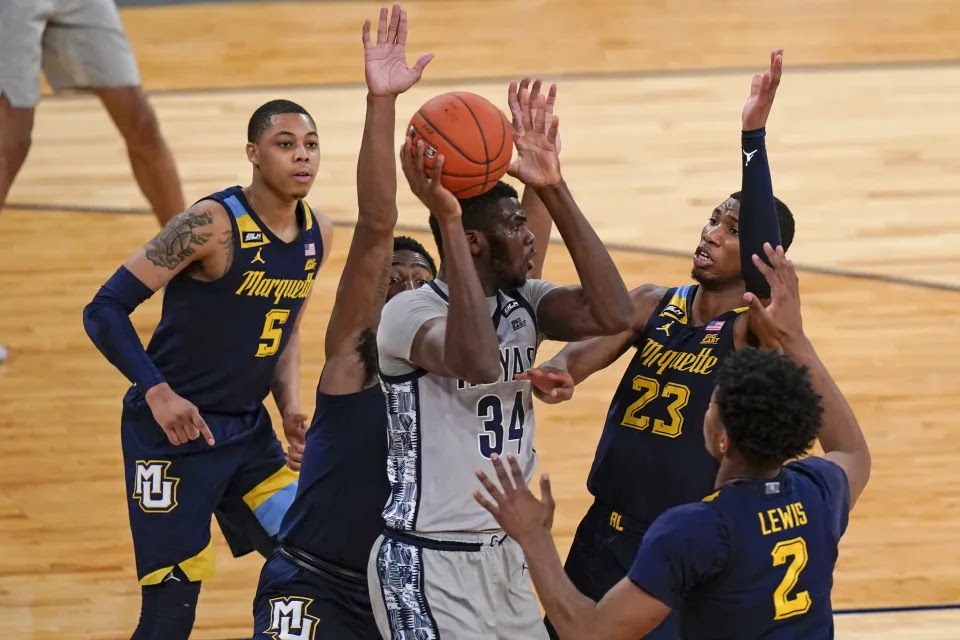
Qudus Wahab is back in the middle for Georgetown
Photo by Frank Franklin II | AP Photo
After a disappointing 2020-21 regular season, there was optimism in D.C. after a Big East Tourney title and NCAA bid. They had Dante Harris back after his BET MVP award, the highest-ranked recruit in the Big East in Aminu Mohammed, and viable three-point threats in Donald Carey and Kaiden Rice. That optimism carried Hoyas fans right up to the opening night, when they lost a buy game to Dartmouth. They did manage to beat rivals Syracuse, but finished non-con a mediocre 6-5. But like the Big East Tournament, conference play is a chance to rejuvenate the season, right? Wrong, in the Hoyas' case. They went 0-19 in the Big East, setting a conference record for regular season losses. They also lost their opener in the conference tournament, becoming the first team since 1994 Miami to go completely winless against conference opponents (even 2009 DePaul won a game at MSG).
In response, Patrick Ewing fired two of his assistant coaches and relegated Louis Orr to a developmental role, opening the way for three new assistants. That staff also brought in five new transfers to start the season. At a glance, Primo Spears fits in perfectly, in that he's a high-usage, low efficiency guard whose previous team lost seventeen straight games against conference foes to end the season. Jay Heath is a more reliable shooter who spent time at Arizona State and Boston College, but like Spears has never played for a program that finished the season with a record above .500. Brandon Murray is the prized recruit, and the reason Patrick Ewing brought in Kevin Nickelberry from LSU. Murray started for the Tigers, averaging 10.0 ppg for a tourney team last year. Akok Akok is a long, athletic forward that brings a defensive edge and ability to stretch the floor. Qudus Wahab is a boomerang transfer, having left Georgetown for Maryland a year ago only to return after Kevin Willard took over. Wahab was effective as a rim protector and rebounder for Ewing but didn't have as big a role as he might have liked with the Terrapins. Harris is also back, though expected to come off the bench after being a disappointment last year. They also have a mix of experienced transfers in Bryson Mozone and Wayne Bristol as well as freshmen in Denver Anglin and D'Ante Bass that are expected to contribute.
The hope for the Hoyas will be getting back to what Ewing wants to do. They like to run four-out around a big, with Wahab having succeeded in that role before and the other four all capable of knocking down outside shots. Last year they had Aminu Mohammed to slash to the rim, but none of their current guards are nearly as good at attacking through contact. Wahab will stay down low, expected to clean the glass. Offensive rebounding is the one thing Ewing's teams have consistently done well and Wahab, Akok, and reserve center Ryan Mutombo should all keep that up. On defense, it's all funneling teams to the middle and having the shot-blocker shut down the opposing attackers. As a consequence, they don't deny passing lanes, create turnovers, or pay much attention to the three-point arc, which has led to four of five seasons outside the top-100, punctuated by a Ewing-worst #228 last year. Generally, Ewing's teams don't seem to care much about defending. If they are going to turn things around, that has to change, but it's hard to envision an entirely new starting lineup finding much cohesion, especially early on.
Let's be frank, if literally anyone on earth not named Patrick Ewing had one winning season in five years and had a winless Big East season at Georgetown, they would be cashing their buyout check. The only reason Ewing is still here is because his name means so much to the University. While there is some excitement around their transfer haul, it's important to put it in context. Wahab had success individually with Ewing, but that team was 9-12, 7-9 in the Big East before their miracle BET run and subsequent implosion in the NCAA Tournament. Akok Akok was a fine role-player for UConn, but injuries limited him to double-digit minutes in just 6 of 36 contests for the Huskies over the past two years, with 26 DNPs in 56 games. Murray had a nice freshman campaign, but he wasn't nearly the player Mohammed was last year, which is why he transferred to Georgetown instead of going to the NBA. And both Spears and Heath come from programs that haven't won. On top of it all, four of the top-five scorers from last year are gone and the one that returned is headed to the bench. It's hard to sell that this team will lose the bulk of their best players and get better on the premise that these players just aren't quite as bad as the old ones were, especially when the guy running things hasn't changed. It's hard to fire a legend, but if Ewing couldn't make a tournament with James Akinjo, Mac McClung, Jessie Govan, Josh LeBlanc, and Jamorko Pickett, why would anyone trust him to do it with this cobbled together roster of role-players and losers, at least in terms of record? If they make it to tenth in the Big East, it should be considered a massive accomplishment, but still shouldn't be enough to save the job of the worst coach in the league.
Marquette Memory: While Patrick Ewing has been poor at Georgetown, one thing he's been good at is finding ways to derail Marquette fan hopes. It started in 2019. After opening Big East play 12-2 and needing just one win to secure a Big East title, Marquette gave up a 5-point lead at Villanova with 5 minutes to play, a 4-point lead against Creighton with 5 minutes to play, and a 9-point lead at Seton Hall with 5 minutes to play. Despite all that, Nova lost at Seton Hall on the final day of the season, putting Marquette in position to share the Big East title with a home win against Georgetown. The teams traded blows in the first half, but after an 11-0 run put Marquette up 8, it looked like the title was coming to Milwaukee. But the Hoyas chipped away, taking back the lead with seven minutes to play and holding on for an 86-84 victory.
Sunday, October 30, 2022
DePaul Preview, 2022-23
DePaul Blue Demons
Head Coach: Tony Stubblefield (15-16 at Butler, 17-28 overall)
Three-Year NET Average: 118.7
Three-Year kenpom Average: 112.7
Projected 2022-23 T-Rank: 89
Projected Starters: PG Jalen Terry (6'0" Jr), SG Umoja Gibson (6'2" RS Sr), SF Javan Johnson (6'6" RS Sr), PF Eral Penn (6'7" RS Sr), C Nick Ongenda (6'11" Sr)

Tony Stubblefield is leading the Blue Blue Blue Demons
Photo from USA Today Sports
The first year of Tony Stubblefield looked a lot like the second tenure of Dave Leitao. They had a strong non-conference performance, going 9-1, then fell flat in conference play, beginning 1-9 en route to a bottom-two finish, marking the seventh straight year they landed at or near the bottom of the league. From that team, they lost their top-three scorers, including wing David Jones who transferred to St. John's. One year after starting his rebuild, Stubblefield looks to be rebuilding again.
The good news is that Jalen Terry and Nick Ongenda are back, giving some consistency at the point and center positions. Terry, however, has been turnover-prone and only a marginally effective shooter. Ongenda, on the other hand, seems to be developing in reverse. He posted a career high in minutes last year but career lows in eFG%, defensive rebounding rate, and block rate. The more he plays and the higher his usage gets, the less effective he seems. A pair of transfers join them in the starting lineup. Umoja Gibson blossomed as a scorer for Oklahoma last year, putting up a highly efficient 13.3 ppg. He's a bucket and will be expected to take much of the Javon Freeman-Liberty role. Eral Penn was a late transfer from LIU who was first team all-Northeast Conference last year and has been a high-level scorer and rebounder, but at a lower level. The other expected starter is Javan Johnson, who really seemed to be blossoming in late January before a hand injury ended his season. The wildcard might be Caleb Murphy, who is being touted as a future pro, but in two years at South Florida he was a high-usage, low efficiency volume shooter who primarily served as a drag on the Bulls' offense. Big man Yor Anei, wing Philmon Gebrewhit, and talented freshman guard Zion Cruz provide additional options for Stubblefield.
While DePaul started conference play terribly, they finished it much better. The Blue Demons went 5-6 beginning in February. Limiting turnovers went a long way in that improvement. Stubblefield is looking to reinforce the back court improvement by bringing in Gibson and Murphy. His hope also has to be improving their shot-making, particularly when 4 of their top 5 in terms of three point makes last year are gone. Gibson should help, but neither Murphy nor Penn cracked 30% last year so it's hard to see where that shooting will come from. On defense, their big man tandem provides solid rim protection and helps limit inside scoring, but as a team they give up too many threes, allow too many offensive boards, and don't turn teams over. Stubblefield is trying to put length at every position, but this was not a good defensive team.
What likely makes this even more frustrating for DePaul fans is looking at the age of the roster. After the first year of the rebuild, they lost their top-three scorers. This year, their rotation will feature four graduate seniors that aren't eligible to return and two more seniors that could also depart. It's hard to see how Stubblefield can build a foundation for the future when he only has two freshmen and no sophomores on the roster. If everything goes right this year, maybe Gibson, Murphy, and Penn can replicate what Freeman-Liberty, Jones, and Brandon Johnson provided last year. Maybe JUCO Da'Sean Nelson can be a different but equally effective bench presence to what Courvoisier MacCauley gave them. But even with those players, DePaul was one of the worst teams in the league, so if the new pieces come in and equal them, this is still a bad team. It must be hard to find optimism in Chicago when the best case scenario looks like bottom-3 in the league and there's a good chance 6 starters or rotation players will be gone at the end of the year.
Marquette Memory: When Tom Crean took over at Marquette, the hope was that he would return Marquette to the relevance they had a few years earlier before Kevin O'Neill left. They started the 1999-2000 season 8-4 and were staring down a three-game gauntlet of ranked opponents. After dropping a game to #3 Cincinnati, Crean took his team to Chicago in hopes of notching the program's first win over a ranked opponent in more than three years. Early on, it looked like smooth sailing for Marquette as they took a 36-26 lead into the break, but Quentin Richardson and DePaul seemed to take inspiration from the Blue Demon mascot parading around the Rosemont Horizon with the head of the Marquette mascot on a stick. DePaul rallied to tie the game at 44 and kept it close down the stretch. With the result in doubt, Cordell Henry and Olouma Nnamaka took over. First, Henry nailed a three to stretch the lead, then Nnamaka made a pair of baskets to put it away. Marquette beat DePaul 69-60 and followed that up with an overtime win over Louisville to take two of three from the most difficult stretch of the season.
Saturday, October 29, 2022
Creighton Preview, 2022-23
Creighton Bluejays
Head Coach: Greg McDermott (276-137 at Creighton, 556-332 overall)
Three-Year NET Average: 29.7
Three-Year kenpom Average: 28.0
Projected 2022-23 T-Rank: 23
Projected Starters: PG Ryan Nembhard (6'0" So), SG Trey Alexander (6'4" So), SF Baylor Scheierman (6'7" Sr), PF Arthur Kaluma (6'7" So), C Ryan Kalkbrenner (7'1" Jr)
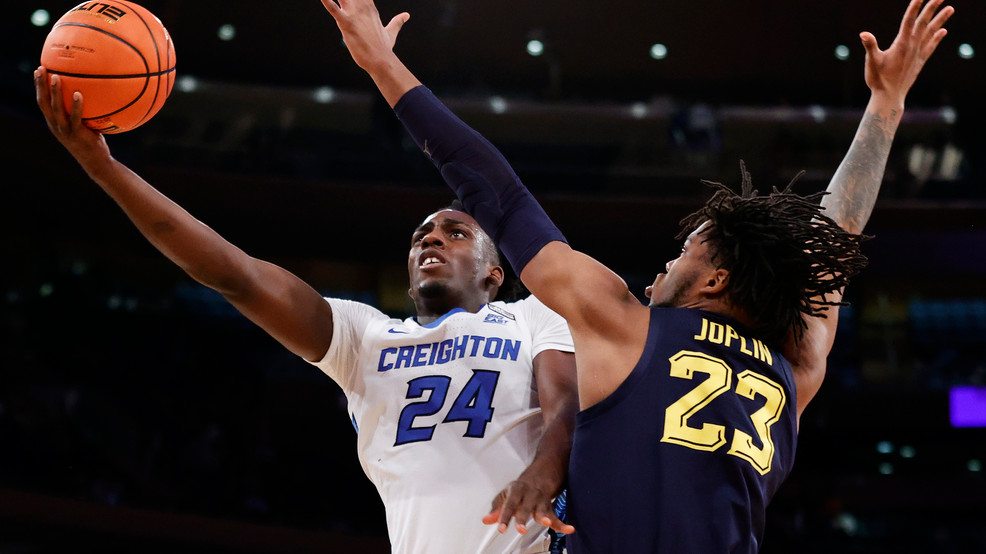
Arthur Kaluma and Creighton went 3-0 against Marquette in 2021-22
Photo by Tim Nwuchukwu | Getty Images
The lasting image of Creighton from 2021-22 is a team that took eventual national champions Kansas to the limit, as the short-handed Bluejays cut a 9-point deficit down to just one with a minute to play before succumbing to the superior Jayhawks. That came on the heels of a spirited 3-2 stretch that began with them ranked #70 in kenpom entering the Big East Tournament before earning wins over Marquette, Providence, and San Diego State. Their non-conference was marred not just by a loss to a bad Arizona State team but needing second-half comebacks to beat Kennesaw State, Southern Illinois, and SIU-Edwardsville. In league play, they opened with a dominating performance over Villanova, but as good as they looked in that game, they looked equally bad in most of their losses, dropping four Big East games by 17+ points. Because of that inconsistency, Creighton finished the season 50th in kenpom, and proceeded to lose their best player in Ryan Hawkins and their only other shooter over 32% from deep in Alex O'Connell.
Where Creighton gets their optimism is in their returners. Ryan Nembhard showed flashes of brilliance before a season-ending injury, though he desperately needs to improve his shooting (31.1% 3PFG%) and turnover rate if he is going to develop into an elite Big East guard. Trey Alexander is regarded as the best NBA prospect on the roster, despite similar turnover propensity and worse shooting from deep. Arthur Kaluma has the kind of usage and all-around impact numbers that foreshadowed Justin Lewis' breakout for Marquette, though he would require a similar efficiency improvement to match Lewis' impact. Ryan Kalkbrenner is the most proven returning player, as he's a high-efficiency big that dominates the offensive glass and is won Big East Defensive Player of the Year not only due to his rim protector but in how he shuts down opposing drive-and-kick efforts. Joining them is South Dakota State star Baylor Scheierman, who on paper looks like the high-efficiency sniper Creighton needs to replace Hawkins. Off the bench, Shereef Mitchell is a defensive specialist who missed most of last season with an injury while Francisco Farabello gives another long-range threat off the bench after transferring in from TCU.
Offensively, last year Creighton was a mess. It was the first time in 12 years McDermott's offense was outside the top-66, and at 112 was WAY outside. That was in large part because they were terrible shooting from deep and turned it over way too often, ranking sub-300 in both categories. Typically, McDermott's teams move the ball quickly and effectively, putting multiple shooters on the floor and spraying in threes from a four-out attack. Last year, it was unexpectedly the defense that was Creighton's strength. It was the first time McDermott had a top-30 defense at Creighton. Kalkbrenner was a big part of that because he was effective not just at closing the lane with his length and swatting shots, but doing both without fouling. However, when it comes to the best defensive lineups, it was Ryan Hawkins and not Kalkbrenner that showed up on the floor. Just look at the on/off numbers for Hawkins:

Ryan Hawkins On/Off splits from Hoop-Explorer.com
Granted, Creighton played far more possessions with Hawkins than without him, which probably includes some garbage time, but when he went off the floor their offense and defense both went in the toilet. No other player on their team had such a drastic impact on both ends. One of the biggest worries this year has to be Scheierman, who is expected to take many of Hawkins' minutes. With the Jackrabbits, he played for teams ranked #241, #222, and #217 in defense, and did so in a league that never had a team in the top-100 of adjusted defensive efficiency.
If everything goes right for Creighton, predictions of a Big East title and top-10 ranking make sense. But there are a lot of ifs. Alexander (97.1 Adjusted Offensive Rating), Nembhard (91.5), and Kaluma (90.5) were all low-efficiency players that each need to make Justin Lewis type jumps to be what prognosticators are predicting. For context, out of 70 players that kenpom rated in terms of offensive efficiency, Creighton's freshman trio ranked #58, #69, and #70. They are literally counting on 3 of the 13 worst qualifying players in the league to have breakout seasons. And while Scheierman has some gaudy offensive numbers, he was miserable last year against high-level competition, which is all he will see this year, and has never had to play defense at this level. Kalkbrenner is a potent force on both ends of the court, but he can't do it alone. If three freshmen have breakout sophomore seasons, if Scheierman can produce on both ends like Hawkins, if their transfers and freshmen can be proven contributors, if the overall defense can return to McDermott's average levels without a noticeable talent upgrade, and if Kalkbrenner can anchor another top-20 defense, they can be what people are predicting them to be. Those are a lot of ifs.
As Jim Root from Three Man Weave noted, in the past 15 years, there have been 28 teams that finished outside the kenpom top-25 and were predicted to be top-10 teams the following year in the AP Poll, and just 28.6% of them delivered on that hope. And of those eight teams, only ONE went from outside the top-40 (like Creighton) to the top-10, and that was last year's Kentucky which added the National Player of the Year and a one-and-done first round NBA Draft pick. Creighton did not do that. This should be a tournament team but has the look more of a Big East top-half team and single-digit seed than a clear favorite. While the Kansas game left Jays fans on a promising note, last season's results as a whole, the need for so many players to have simultaneous breakout seasons, and the expectation of defensive consistency from a coach that has never shown an aptitude for that would strongly indicate they won't get close to those top-10 projections. There's a reason none of the computer metrics have Creighton in the preseason top-20. It's because jumping from #50 into the top-10 simply isn't something that happens very often, especially not without a significant talent upgrade, and in trading Hawkins and O'Connell for Scheierman and Farabello, Creighton may have gone in the opposite direction.
Marquette Memory: Marquette fans will remember it as one of the greatest buzzer-beaters they've ever seen. Creighton fans still think it should have been waved off. And despite the controversy of the shot, many fans will remember it as the night Markus Howard scored a Big East record 53 points in a game. On January 9, 2019, the #21 ranked Golden Eagles traveled to Omaha. They came in as slight underdogs and Creighton soon showed why, establishing a double-digit lead midway through the first half. In fact, after the first basket was scored, Marquette never led and was never tied during regulation. And when Martin Krampelj's free throws made it 85-80 with 8 seconds to play, the game looked over. Sam Hauser tried a three to close the gap but missed. Joe Chartouny grabbed the rebound but missed a bunny under the hoop. He managed to get his own rebound and put it back in with 0.8 seconds on the clock. All Creighton had to do was inbound the ball and the game would be over. Instead, Connor Cashaw threw a Hail Mary style pass that was too long for Krampelj and the ball bounced out of bounds, giving Marquette an inbound under the basket with 0.8 to play. Howard lofted an inbound pass to Sam Hauser, who caught, rose, fired, and hit a miracle three at the buzzer to send the game to overtime. Even slowing the video and watching frame by frame, there's never a clear image of the shot being off. It's in Hauser's hand at 0.1, then out at 0.0, but there's no frame in between that shows the exact instant of release. In overtime, Howard took over. He scored 14 of his record-breaking 53 points in overtime, including the first 11 of the extra frame for Marquette. In a reversal of regulation, once the first overtime basket was scored, Creighton never led and was never tied during overtime. Marquette went on to escape with a 106-104 victory.
Friday, October 28, 2022
Connecticut Preview, 2022-23
Connecticut Huskies
Head Coach: Dan Hurley (73-47 at Connecticut, 224-152 overall)
Three-Year NET Average: 37.0
Three-Year kenpom Average: 31.7
Projected 2022-23 T-Rank: 61
Projected Starters: PG Tristen Newton (6'5" Sr), SG Nahiem Alleyne (6'4" Sr), SF Jordan Hawkins (6'5" So), PF Andre Jackson (6'6" Jr), C Adama Sanogo (6'9" Jr)

Adama Sanogo is the Big East Preseason Player of the Year
Photo by Ian Bethune | The UConn Blog
Dan Hurley finally seems to be settling UConn back into the top-25 range. Fans will be heartened by consecutive single-digit seeds, with last year's team earning a 5-seed even after losing star guard James Bouknight. That was largely driven by the trio of R.J. Cole, who was an effective scorer and distributor, Tyrese Martin, a sharp-shooting wing with an excellent all-around game, and Adama Sanogo, the space-eater in the middle who posted 9 double-doubles last season. Unfortunately for Husky fans, Cole and Martin are gone, along with defensive stopper Isaiah Whaley and sixth man Tyler Polley.
Everything will start with Sanogo, who was named Big East Preseason Player of the Year. He's the kind of player who can vacuum up rebounds, block shots, and impose his will physically on opponents. The biggest question will be who can get him the ball. Tristen Newton will likely get the first shot at replacing Cole. He's a big guard who averaged 17.7 ppg/5.0 apg last season, but did so for East Carolina, a team that finished in the bottom-3 of the American every year he was there. He's joined by Nahiem Alleyne, who was effective as a secondary or tertiary option for Virginia Tech but has consistently shown he can knock down open shots. Jordan Hawkins and Andre Jackson were big time recruits that fans are hoping will break out this year. Both have viable NBA aspirations and are explosive athletes but thus far haven't translated that into on-court consistency. They need to step up for UConn to maintain that top-25 status. The roster boasts some depth as well, with Texas A&M transfer Hassan Diarra having microwave scoring ability, redshirt freshman Alex Karaban providing shooting depth, and 7'2" freshman Donovan Clingan providing depth behind Sanogo.
In Hartford, Hurley's teams have primarily gotten offense out of imposing their physical will on opponents. His teams have turned in back-to-back top-30 offenses with only one of the four factors ranking in the top-100, and it was offensive rebounding both times. They were #4 in 2020-21 and #2 last year. They haven't even been good at finishing inside, ranking outside the top-230 in 2PFG% both years, but having bigs like Sanogo, Whaley, and Martin attacking the offensive glass kept giving them opportunities. To continue thriving like that, they need Jackson and Hawkins to be more aggressive on the offensive glass. Defensively, UConn is the team more concerned with winning the fight than the game. They will hammer opponents inside, limiting 2PFG% while blocking shots at a high rate. They also aren't afraid to foul, as Hurley's teams have ranked outside the top-220 in defensive free throw rate every year of his career going back to Wagner. Adding Clingan will insure they always have an effective rim protector, but the other downside is they let teams take a lot of threes. That has bit them in each of the past two NCAA Tournaments as they lost first round games as favorites to New Mexico State (11/17 from deep) and Maryland (9/18 beyond the arc). The key to beating UConn is not getting drawn inside, but being patient enough to move the ball around for the perimeter shot and connecting on those.
The biggest question for Connecticut will be how the pieces fit together. Sanogo's return is huge, but they lost four of their top-five scorers. Hawkins and Jackson have the talent to star, but have to deliver on that promise and look like NBA talents consistently, not just in isolated athletic spurts. Newton and Alleyne look like nice pieces, but they have to translate what they did elsewhere. And none of the major reserves are players that have done it in this system. They should finish in the top-half of the Big East and earn a tourney bid, but whether Sanogo is a legit BEPOY contender, whether the returners deliver on their promise, and how well the newcomers fit in will determine the difference between a possible protected seed and a team closer to a double-digit seed.
Marquette Memory: When UConn left the Big East in 2013, they only faced Marquette once that season. It was a snowy night in Milwaukee and for most of the game MU fans were pretty comfortable. But after building a double-digit second half lead, it began to slip away. UConn went on a 16-5 run to take the lead, largely because of Marquette's abysmal shooting as they began the night 0/14 from long range. When Ryan Boatright hit a long fade-away jumper with 6 seconds to play to push the lead to 69-66, it looked to be over. Instead, Junior Cadougan pulled up on a deep three to force overtime at the buzzer. Marquette went on to win 82-76 in overtime and send the Huskies out of the Big East with a loss and 3-6 record against Marquette.
Thursday, October 27, 2022
Butler Preview, 2022-23
Butler Bulldogs
Head Coach: Thad Matta (24-8 at Butler, 439-154 overall)
Three-Year NET Average: 86.7
Three-Year kenpom Average: 88.7
Projected 2022-23 T-Rank: 110
Projected Starters: PG Eric Hunter (6'4" RS Sr), SG Chuck Harris (6'2" Jr), SF Simas Lukosius (6'6" So), PF Ali Ali (6'8" Sr), C Manny Bates (6'11" RS Jr)
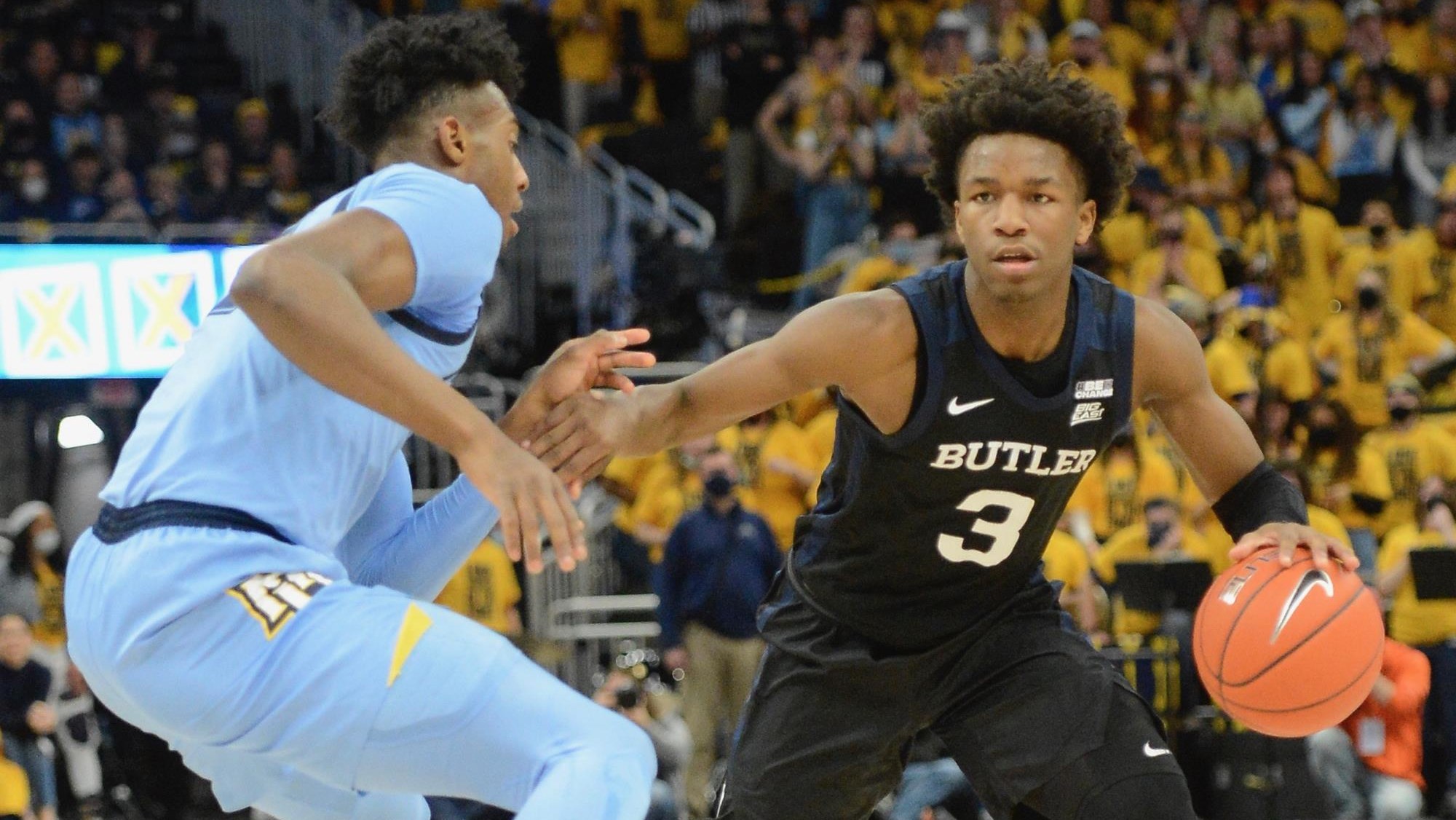
Chuck Harris leads Butler into the second Thad Matta era
Photo from Butler Athletics
In 2020, the Big East lost out big not only because they had three teams favored to make the second weekend, with Villanova, Seton Hall, and Creighton all projected as top-3 seeds, but also because Butler was headed to the NCAA Tournament as a likely 5-seed with similar second weekend aspirations. That tournament never happened, Kamar Baldwin, Sean McDermott, and Jordan Tucker all left, and LaVall Jordan was never able to reconstitute a tourney-caliber roster. They collapsed hard in 2022, going 5-13 after mid-January, though 6 of those losses were decided by two possessions or less. Jordan kept them competitive, but not competitive enough to keep his job. As a result, Jordan was fired and Butler brought back Thad Matta, the two-time Butler assistant who also started his head coaching career there with a stellar 24-8 campaign in 2000-01 that culminated in an NCAA Tournament bid and opening win over Wake Forest.
Butler fans will certainly welcome back Chuck Harris, who's expected to be the star of this team. The mercurial junior has shown the ability to take over games, but can just as easily vanish. His performances against Marquette are a great example of this, tallying 15 points and 5 assists in a win only to follow it up two weeks later with a zero point 0/6 performance where he had more turnovers than assists. He's joined by Simas Lukosius, a potent wing whose free throw success (90%) indicates he is a better shooter than his numbers from distance (26.5%) showed. They are joined by a trio of transfers expected to start. Eric Hunter joins from Purdue where he spent four years as a competent role-player. He's a strong defender who will help on the perimeter and is able to knock down open shots. Ali Ali is a 6'8" scoring forward with shooting ability and length but needs to be tougher on the glass if he wants to compete in the Big East. He also has shot-making ability. The prize of their transfer haul is Manny Bates, a shot-blocking machine who is a force on the offensive glass. In terms of being a defensive eraser, Bates had more blocks in 2019-20 season (83) than Butler has had as a team in any of the last five years. Jayden Taylor and Myles Tate are returners that give them depth in the back court while they'll hope transfer Jalen Thomas will lessen the dropoff when Bates needs a rest.
Historically, Matta's teams are great at ball control, both in terms of turnovers and pace. Their efficiency comes inside where he's had bigs like Greg Oden, Jared Sullinger, and Amir Williams. Slow it down, don't turn it over, hammer the ball inside where they have a size and strength advantage. On defense, his teams are excellent at challenging everything without fouling. If healthy, Bates is the perfect rim protector for his system. Draw teams in to the bigs, then swat everything in sight.
The biggest question may be Matta himself. He hasn't coached since he was fired from Ohio State in 2017 after missing consecutive tournaments for the first time in his career. Health was reportedly the reason he didn't return sooner, so it will remain to be seen how well he adjusts to getting back on the sideline is what has to be considered a high-stress job. And while his starting five looks competitive, depth is a question as they are try to fit a number of pieces together in a hurry. That said, if Harris looks more like his freshman self than last year's inconsistent scorer and if Hunter and Bates can provide steadying veteran experience, there's real upside here. Butler had some clear holes in terms of shot making and defensive length, and Matta addressed that in the transfer window. If everything comes together and they hit their peak, this could be a tourney team come March. Expect them to land in the middle of the Big East, somewhere in the 6-8 range where they spend the season bouncing around the bubble.
Marquette Memory: Few venues have been more a house of horrors for Marquette than Hinkle Fieldhouse was once Butler joined the Big East. Starting with the 2014 overtime loss, Marquette was defeated in five straight trips to Indianapolis, including second half come-from-behind Butler victories in both 2017 and 2018. Marquette came into Indy ranked #10 in the nation in 2019. Rather than Marquette's prolific offense, it was the defense that was on display. Butler was held to 25 points in the first half and managed just 0.85 points per possession for the game. At the other end, All-American Markus Howard poured in 32 points to pace Marquette. It wasn't entirely without drama, as an 11-0 Butler run in the second half got the margin down to 6 with ten minutes to play, but Marquette answered with a 12-0 run of their own and finally broke the Hinkle curse with a 76-58 win.
Wednesday, October 26, 2022
Notre Dame Preview, 2022-23
Notre Dame Fighting Irish
December 11, 2022, South Bend, IN
Head Coach: Mike Brey (472-259 at Notre Dame, 571-310 overall)
Three-Year NET Average: 64.3
Three-Year kenpom Average: 60.0
Projected 2022-23 T-Rank: 32
Projected Starters: PG Trey Wertz (6'5" RS Sr), SG J.J. Starling (6'4" Fr), SF Cormac Ryan (6'5" RS Sr), PF Dane Goodwin (6'6" RS Sr), C Nate Laszewski (6'10" RS Sr)

Nate Laszewski allows Notre Dame to play five-out
Photo by Matt Cashore | USA Today Sports
After a fantastic run of 9 NCAA bids in 11 years, fans in South Bend were starting to wonder if Mike Brey had lost a step. The Irish hadn't had a tourney caliber team in four years and the "Fire Brey" chants started even before the 3-4 start to 2021-22. Then the Irish pulled one of the shockers of the season, knocking off Kentucky, and followed that up with a 15-5 ACC record, good enough for second place albeit in a depleted league, and made it back to the NCAA Tournament, where they beat Rutgers and Alabama and were two minutes from the Sweet 16 before a Texas Tech late comeback ended their season.
Brey's resurgence was largely down to freshman star Blake Wesley, who departed for the NBA. However while the back court of Wesley and Prentiss Hubb is gone, the entire front court of Cormac Ryan, Dane Goodwin, and Nate Laszewski are back. All three are high efficiency scoring options that connected on over 40% of their three point attempts. They are joined by another stud freshman, five-star J.J. Starling, who is more multi-dimensional than Wesley was as not just a scorer but a distributor as well. The biggest question mark is at the point, where Marcus Hammond will get the first crack. While he averaged 18.1 ppg last year, it was for Niagara so he'll have to adjust to high-major competition. If he doesn't work out, Starling may have to shift over because Brey's roster is heavy on wings and bigs but thin in the back court. Freshman forward Ven-Allen Lubin is pushing for a starting spot and would provide rebounding and defense. Sharpshooter Trey Wertz should also be in the rotation and could pick up slack if Hammond isn't ready.
Offensively, Brey's teams might be best described as meticulous. They have been top-100 in Assist Rate in 19 of his 22 seasons in South Bend. Add in that he hasn't had a team rank outside the top-60 in turnover rate since 1998 and the formula is pretty simple. His teams work the pass, grinding down the shot clock and finding the open shooter, and do so without making mistakes. Considering this team is made up of long players that can absolutely throw flames from deep with immense patience, they are a matchup nightmare. Consider this: Notre Dame ranked 16th nationally in three-point percentage last year largely because of the six players that took 60+ long-range attempts. The four returners shot a combined 43.4% from deep and the two that departed shot 30.8%. With that in mind, they should be even better from deep. That said, they aren't without weaknesses. When they do miss, they are terrible offensive rebounding team (#335 nationally was even worse than Marquette's #325) and they don't get to the line often. Then there is the defense. Brey has never had a top-40 defense and his teams average defensive rank was 113.6 over the past decade. A pair of defensive-minded assistants joined the staff last year and started mixing in some 2/3 zone as a changeup, but this is still a team that wins on the offensive end.
Looking at 2022-23, Notre Dame simply has too much firepower to not be in contention for an NCAA bid. They can't afford many injuries but if they stay healthy, they should be a top-half ACC team and in the mix to play in the tourney once again. How far they go will likely come down to Starling. They have a consistent, experienced rotation around him but last year it was the consistent scoring option of Wesley that put them over the top. While they are efficient, none of their returning players are the high usage types that you expect to carry a tourney caliber team. Starling needs to be that guy for Notre Dame to reach their potential. As far as Marquette goes, this will be one of the toughest games of non-con play. It's a true road game against an experienced team with NCAA aspirations. If Marquette can get this one, it would go a long way toward building an NCAA-worthy resume.
What We've Learned: The Irish have been a tough team to figure out. They struggled mightily with their buy game opponents, starting 5-0 by a relatively narrow average margin of 7.8 ppg. After being upset by St. Bonaventure, they returned home to throttle then-20th ranked Michigan State only to follow it up with a loss to a bad Syracuse team. This is a very thin team, playing only 6 players in most games, though the return of Marcus Hammond gives them a little more depth and they'll likely go 7 deep on Sunday. Their starters all average 32+ mpg. Notre Dame also hasn't faced a high-level team that plays at pace, with Tempo #270 St. Bonaventure the fastest team of their tougher competition, so Marquette's top-50 tempo could be a bit of a shock. Stylistically, this team is what we expected. Grind down the pace, don't turn it over, shoot a ton of threes. Defensively, they aren't very good, but they have been great limiting second chances and not fouling, which has allowed them to survive with a miniscule bench. If not for that MSU result, this would look like a game Marquette would handle relatively easily, despite the venue. But considering how Marquette has dealt with slow-paced games (1-3 when playing fewer than 70 possessions) and just how decisively Notre Dame defeated Michigan State, it likely comes down to which Irish team shows up.
Marquette Connection: When Proviso East star Glenn Rivers chose Marquette over Notre Dame, he became the first McDonald's All-American in school history. However it wasn't that choice that cemented his legacy in Marquette vs Notre Dame lore. Digger Phelps brought his #5-ranked Irish to the Mecca on January 10, 1981. Despite being heavy underdogs, Dean Marquardt couldn't miss for Marquette, going 6/6 from the floor. That performance kept Marquette in the game and Michael Wilson forced a late tie-up and jump ball with the score tied at 52. Notre Dame won that tip, but lost the ball out of bounds. With just one second on the clock, Wilson fired an inbound pass to a streaking Rivers, who took one step and fired up a desperation 30-foot heave that banked in and secured the 54-52 victory.

Subscribe to:
Posts (Atom)